
The general election has raised many questions about the functioning of the UK’s electoral system. In this post, Alan Renwick focuses on two main areas: the First Past the Post rules that form the core of that system; and the quality of democratic discourse during the campaign. The election result illustrates the arguments both for and against First Past the Post; change in this area is unlikely. But, he argues, the need to improve democratic discourse is more pressing than ever.
The 2024 general election having concluded, we can begin to assess how the voting system performed. On one level, the electoral process was a resounding success. Nowhere did the system collapse. Nowhere are the results contested. Losing candidates up and down the country accepted their fates – often, though sadly not always, with good grace. As outgoing Prime Minister Rishi Sunak said in his concession speech on election night, ‘Today, power will change hands in a peaceful and orderly manner, with good will on all sides. That is something that should give us all confidence in our country’s stability and future.’
Other aspects of electoral administration will take longer to gather evidence on. There were numerous reports during the campaign of voters not receiving their postal ballots on time, and some councils took emergency measures in response. The Electoral Commission will now collect thorough evidence on the extent of the problems, and may recommend reforms. This is no trifling matter: over a fifth of voters now cast their ballots by post, and they need to be able to participate with confidence. Similarly, the impact of new voter ID rules will also need careful examination.
This blogpost focuses on two other aspects of the election process: the performance of the core of the voting system itself; and the nature of political discourse during the campaign.
The performance of First Past the Post
UK general elections use the First Past the Post electoral system. At least at first sight, the election result perfectly illustrated the cases both for and against that system.
The greatest benefit of First Past the Post – at least according to its advocates – is that it allows the voters, rather than post-election negotiations between political parties, to decide who will govern. It does this by, typically, giving a single party a majority of parliamentary seats, so voters can throw out a government they dislike and install another. In fact, such clean transitions are rarer than the system’s cheerleaders would have us believe: until last week, a secure governing majority for one party had been replaced by a secure governing majority for another only once since 1945 – in 1970. But the election just concluded has delivered the most decisive transition of the postwar era: a Conservative government originally elected with a majority of 80 has been replaced by a Labour government with a majority of 172.
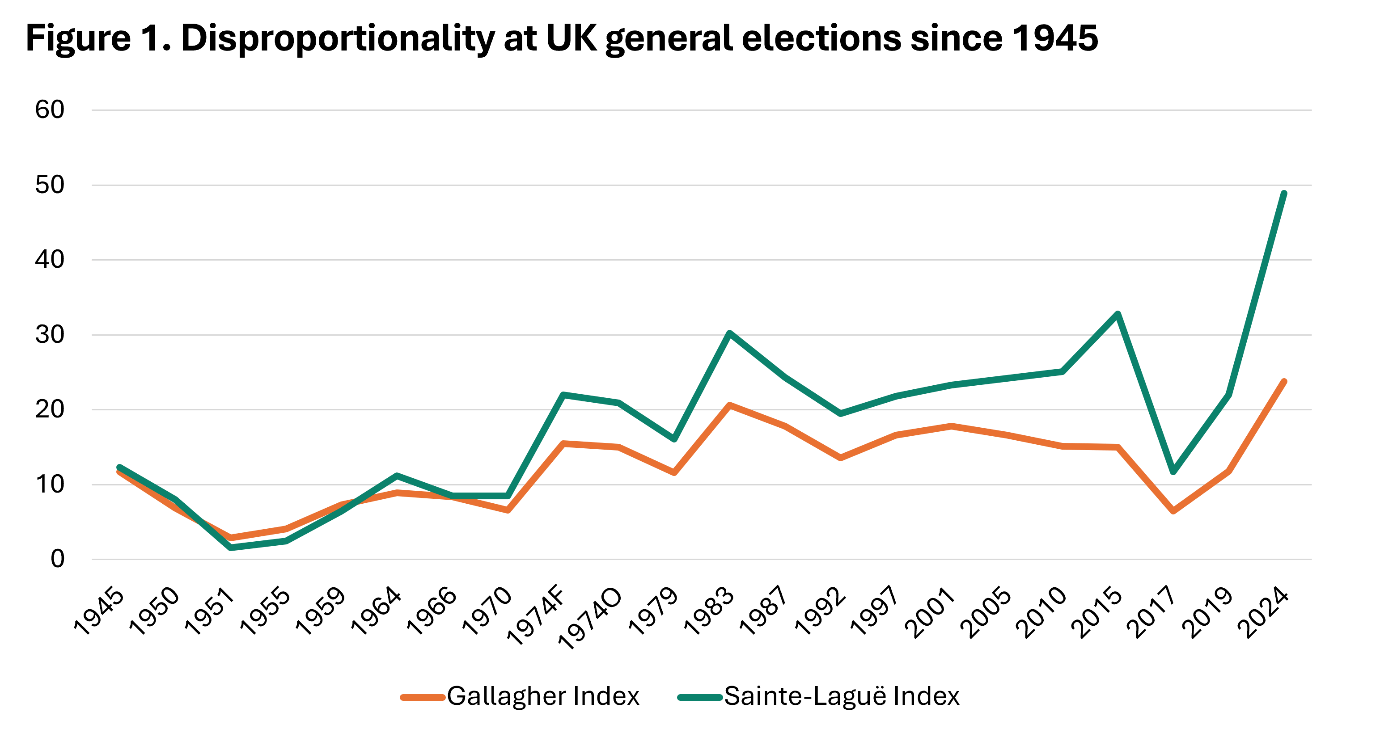
First Past the Post’s critics, meanwhile, focus primarily on the disproportionality of the results that it generates. Parliament is supposed to represent the nation. It cannot adequately do that if the seat shares of the various political parties are markedly out of kilter with those parties’ shares of the votes cast. Exactly how electoral disproportionality should be measured is debated. By any reasonable measure, however, the 2024 election was – by a long stretch – the most disproportional since 1945. Figure 1 shows two such measures. The Gallagher index is the most widely used, while the Sainte Laguë index, I have argued previously, better captures the underlying concept.
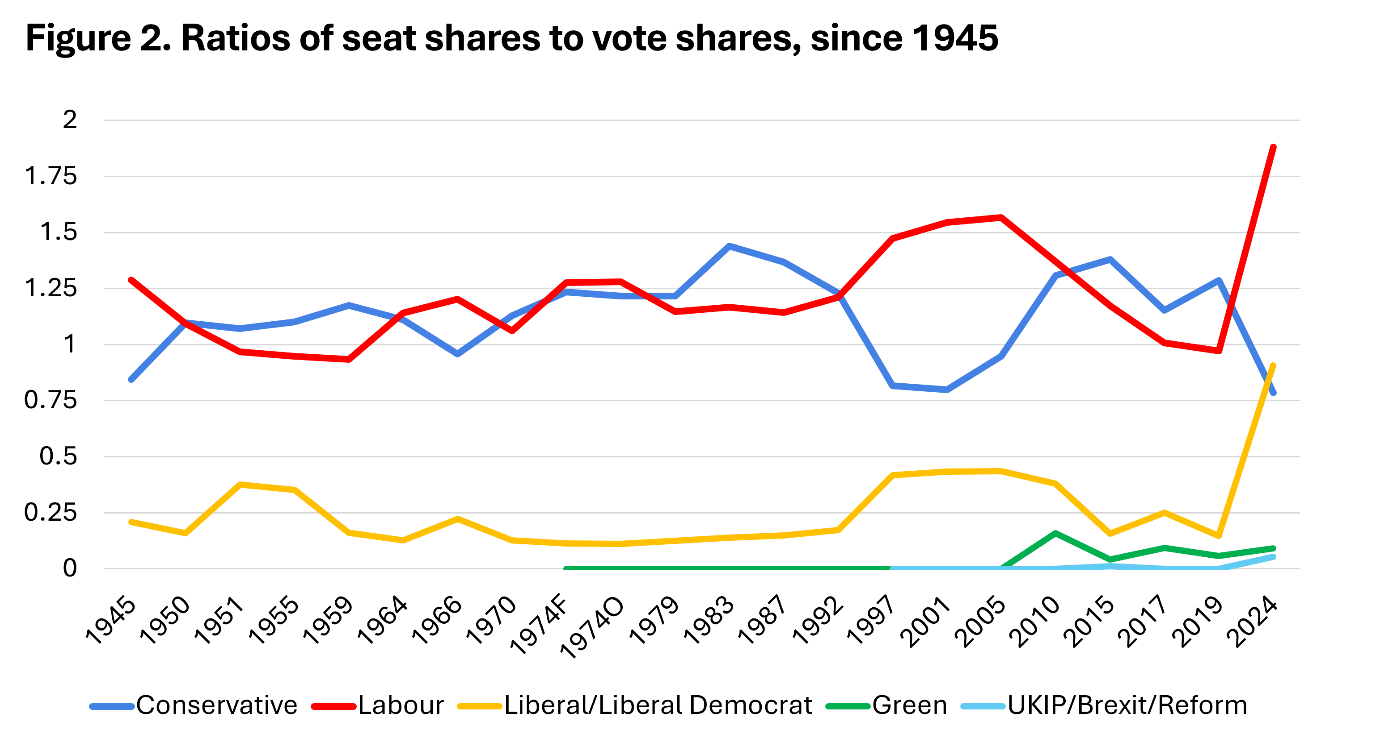
The major factor in that pattern was the over-representation of the Labour Party, which secured 63.4% of the seats on just 33.7% of the votes. In absolute terms, this was the largest over-representation for any party in postwar history. As Figure 2 shows, it was also the most favourable ratio of seats to votes obtained by either of the main parties over the same period. Reform UK and, to a lesser extent, the Conservatives were meanwhile under-represented. For once, the Liberal Democrats secured almost their proportional seat share.
The arguments both for and against reform of the First Past the Post system thus seem to be strengthened by the result. But we have looked so far only at the headlines. If we scratch further beneath the surface, the election also illustrates those arguments’ weaknesses.
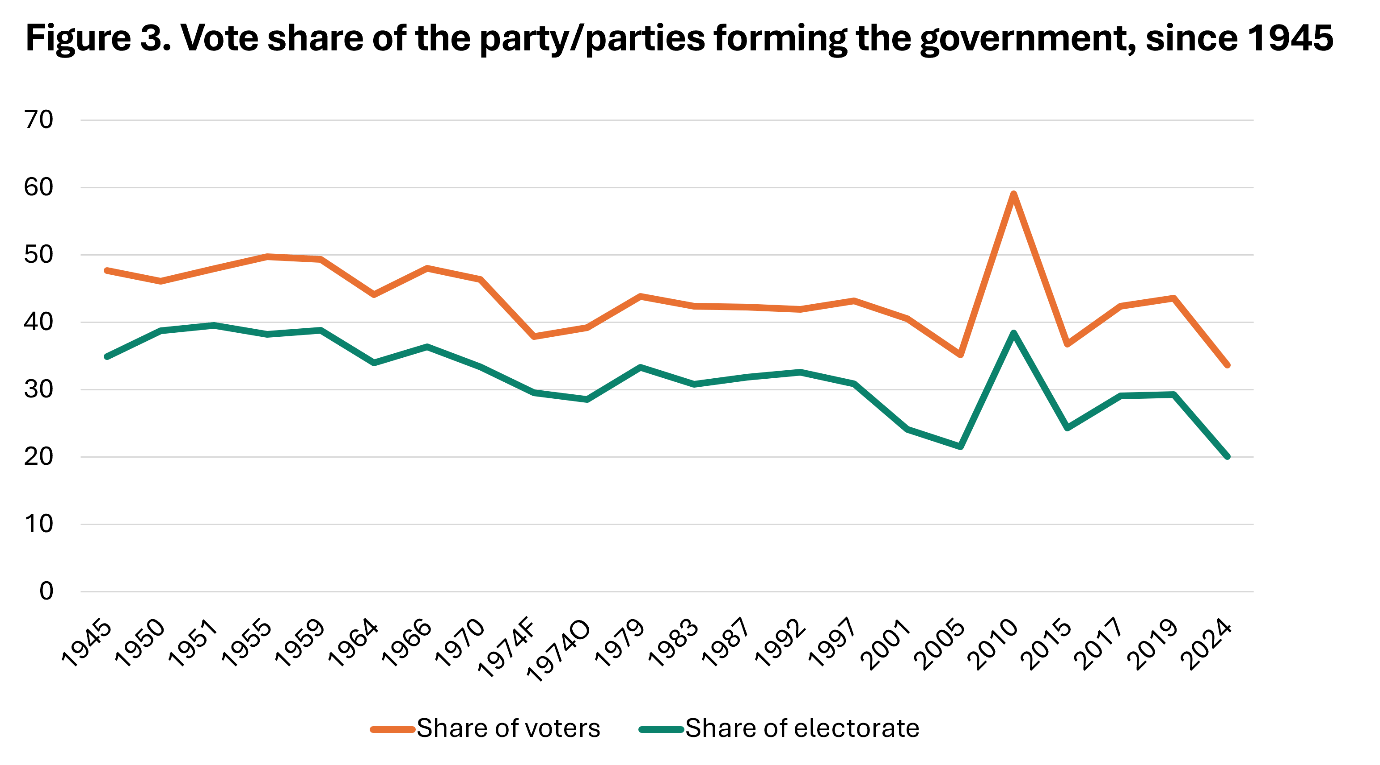
As regards the case for First Past the Post, there is clearly a difficulty in saying that the result illustrates voter control over government formation when the winning party secured only a fraction more than a third of the votes cast. Indeed, when we also take account of turnout – which, at 59.7%, was only just above the post-1945 low reached in 2001 – Labour’s claim to a governing mandate is, as Figure 3 shows, weaker still. Just 20.1% of eligible electors cast a ballot in Labour’s favour, beating the previous post-1945 record of 21.6% reached in 2005.
As to the pro-reform argument, the claim that seat shares ought to equal vote shares asks us to assume that there are discrete viewpoints in the electorate that the various parties represent, and that voters choose the party that is closest to them. Yet the 2024 election has illustrated perhaps better than any previous one that this picture is too simplistic. Many electors voted tactically, casting their ballot not for their first preference, but for a candidate they could tolerate who was better placed to defeat another. Furthermore, several parties – particularly Labour, the Liberal Democrats, and the Greens – ran very effective targeted campaigns, further skewing the results. We cannot read off from the overall vote totals what the parties’ seat shares in a ‘fair’ contest ought to have been.
In sum, supporters of electoral reform will see their case as strengthened by this election result, and will push hard for change; but advocates of the status quo will also find much to consolidate their existing view. Having secured a landslide majority, Labour’s leaders are hardly likely to seek change in the system that gave them victory. And, believing in the value of clear government accountability to voters and strong majorities, they may feel that they have right as well as self-interest on their side. At least in the short term, therefore, any shift away from First Past the Post seems highly unlikely.
Yet the longer term is less certain. The combined Labour and Conservative vote share, at 57.4%, was well below the previous post-war low of 65.1%, reached in 2010. As Figure 4 shows, this fits with a gradual, though jagged, trend towards greater party system fragmentation evident since the 1970s.
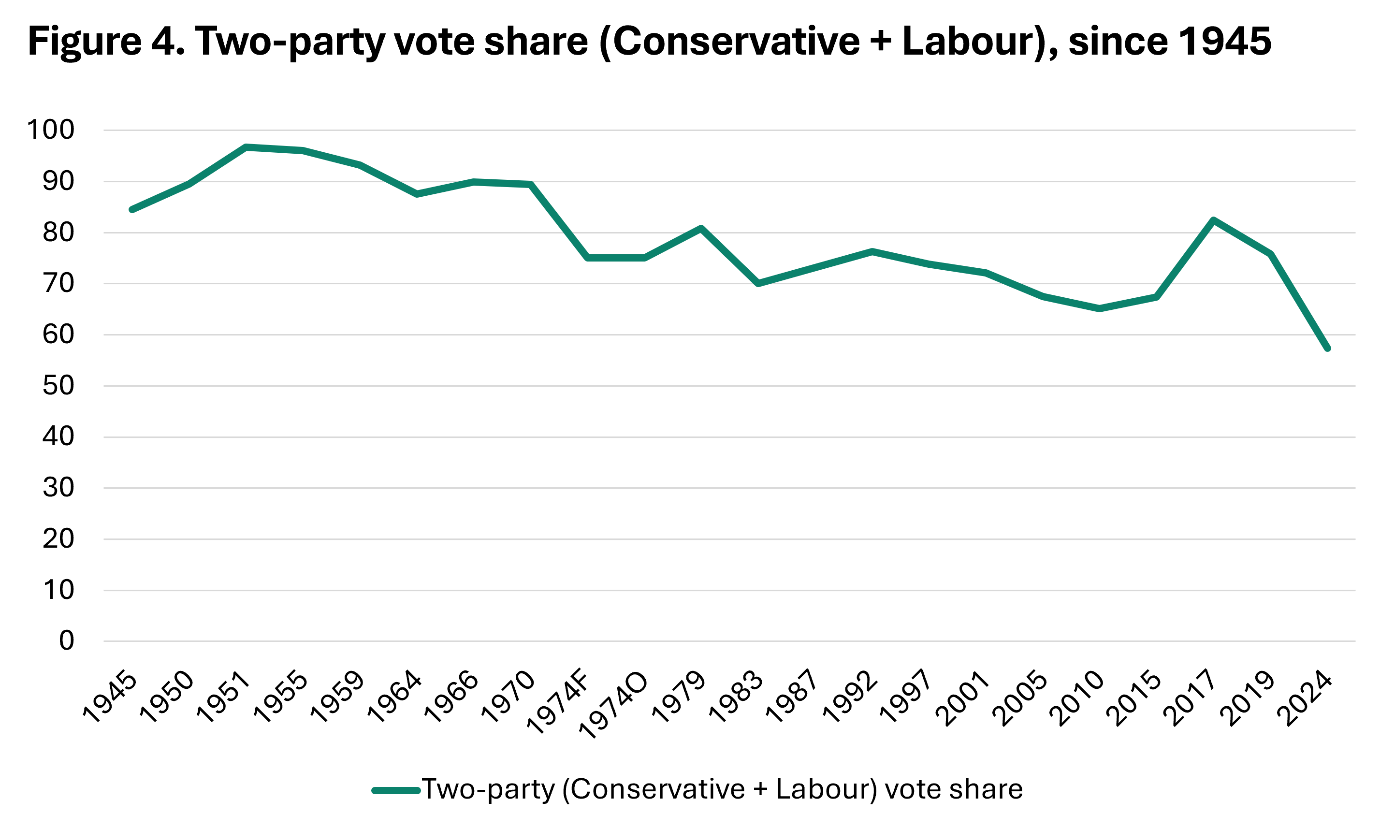
Such fragmentation tends to make election results less predictable and single-party majorities harder to build, thereby weakening both the democratic case for First Past the Post and the large parties’ self-interest in maintaining it. Should such trends continue, core electoral reform may rise up the agenda in the years to come.
Discourse during the campaign
When democracy campaigners speak of electoral reform, they tend to mean the replacement of First Past the Post with some alternative. But the electoral system encompasses much more than that (see recent posts on the Constitution Unit’s blog on rule changes since 2019 and on manifesto pledges relating to elections in 2024). I mentioned postal voting and voter ID above. Questions relating to wider election administration and to campaign finance also matter, as discussed in a Unit seminar held in April.
Perhaps most important on the wider agenda, however, is the discourse of election campaigning. As our recent research into public attitudes to democracy has shown, the aspect of democratic process that people in the UK are most dissatisfied with is dishonesty. Time and again, the evidence we gathered pointed to the importance people attach to integrity, truthfulness, and respect.
Sadly, the campaign showed numerous examples of dishonesty and disrespect. Labour MPs Shabana Mahmood and Jess Phillips – both narrowly re-elected in their Birmingham seats – spoke of the aggressive intimidation and abuse that they and their supporters endured. An alleged audio clip of fellow Labour candidate Wes Streeting in which a voice sounding like his said he did not care about the deaths of innocent Palestinians was assessed to be false by the BBC. On the other side of the political spectrum, investigations by ABC found Facebook pages producing Islamophobic, anti-immigration content that ‘had the hallmarks of a Russian influence operation’.
Such examples might suggest that the problem was confined to the fringes of politics. But mainstream parties produced deceptive content too. Conservatives portrayed a claim that a Labour government would have to raise taxes by £2000 per working household as prepared by civil servants, even though it was not; they later repeated the figure even though it was branded unreliable and misleading. Likewise, a Labour claim about the impact of its policies on electricity bills was found to be outdated and misleading.
More broadly, the Institute for Fiscal Studies accused all the main parties of a ‘conspiracy of silence’ over the difficult choices that, in its view, inevitably lie ahead, between tax rises and spending cuts. And, while the most abusive behaviour may have come from the fringes, the main parties were guilty of negative campaigning too. Outgoing Conservative ministers were praised for magnanimous messages to their Labour successors in the wake of defeat; but hours earlier their party was suggesting a Starmer government would imperil the country.
As our research showed, when people complain of dishonesty in politics, they are referring not just to outright lies. They also want politicians to speak openly about difficult decisions, even when the news is bad, to avoid optimistic spin, and to apologise when they make mistakes. Most people also want a discourse in which campaigners respect the other side.
Politicians may fairly respond that such honesty would render them unelectable: that, whatever people may want in the abstract, they will not vote for candidates who confront them with such hard choices. There is also some evidence that negative campaigning works.
But the conclusion that we should draw from this is not that striving for improvement is hopeless, but rather that the problems, and therefore the solutions, are systemic. Neither blaming politicians alone for the ills of our contemporary political discourse, nor just exhorting them to do better, can be enough. Rather, as I have argued elsewhere, deeper changes are needed that will shift expectations and incentive structures. Working towards such changes – in education, in the media, in how members of the public are included in policy conversations, as well as in the functioning of parliament and government – should be a major focus for all who care about our democracy in the years ahead.
Parts of this post will appear in shorter form in a volume of snap election analysis to be published on 15 July. We are grateful to the editors of that volume for permission to publish this material here.
This post is the latest piece of analysis from the Unit about the 2024 general election. To see a complete list of our output (such as blogposts and reports), visit the 2024 election section of our website.
About the author
Alan Renwick is Professor of Democratic Politics at UCL and Deputy Director of the Constitution Unit.