Democratic backsliding remains a threat to democracy across the globe, with elected political leaders in many countries using their political mandate to dilute constitutional protections and weaken democratic institutions. Joep van Lit and Carolien van Ham explain the seven key modes of ‘autocratisation’ and their creation of a ‘shopping list’ of autocratic behaviours that offers a practical resource to recognise early warning signs of democratic recession.
In times where autocratisation, rather than democratic stability or even increased democratisation, seems to be the norm, there is surprisingly little knowledge about the specific actions that contribute to autocratisation: a process in which politics becomes increasingly exclusive and monopolistic and political power becomes increasingly repressive and arbitrary. In this post, we provide a comprehensive overview of those specific actions that contribute to autocratisation, allowing policy makers and academics to recognise it early on and criticise potentially harmful proposals on their democratic merits.
In our paper, The would-be autocrats’ toolkit: what do incumbents do when they undermine democracy?, we look at one specific type of autocratisation, which we call incumbent-led democratic recession (see Figure 1 below). This type of autocratisation is incumbent-led, because it is initiated by those political leaders who can rely on a plurality (if not a majority) of votes during elections and seats in parliament. These ‘would-be autocrats’ as we call them, have been voted into office by citizens through democratic elections, but once in power, proceed to undermine democracy from within. Additionally, it is democratic recession rather than democratic breakdown into autocracy, because the country stays somewhat democratic – just less democratic than before. Typical cases include Orbán’s Hungary, Modi’s India, and Trump’s USA, but incumbent-led democratic recession is a global phenomenon (see Figure 2). Since 1990, about half of all episodes of autocratisation globally are instances of incumbent-led democratic recession.
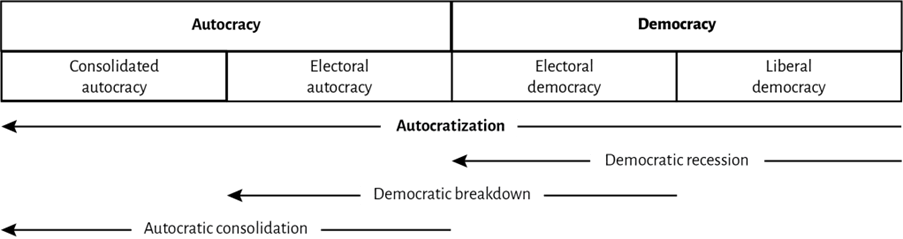
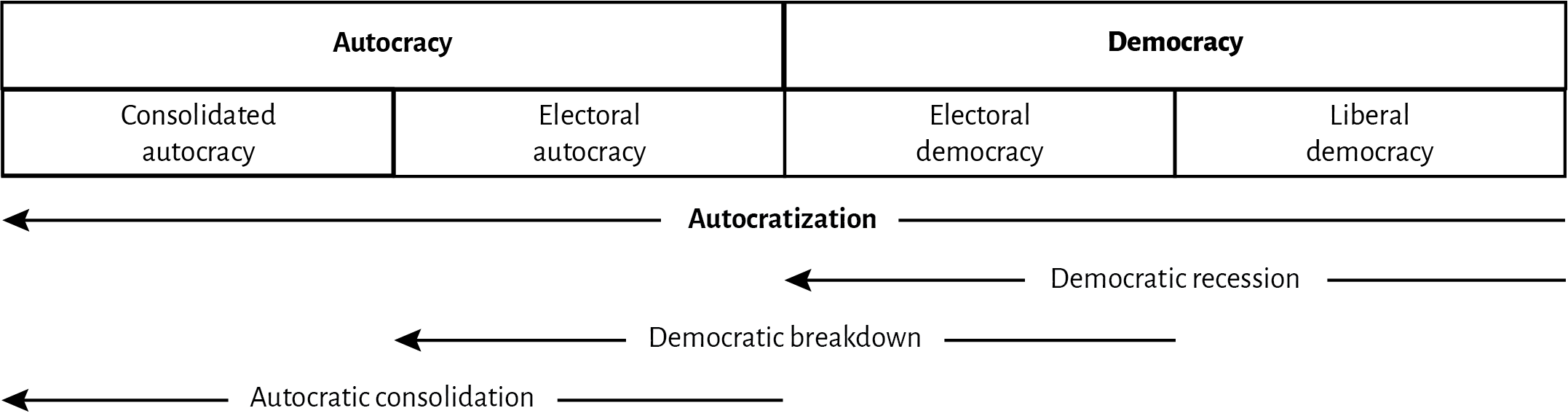
Figure 1: Democratic recession as a specific type of autocratisation (figure based on this book and this paper)
Incumbent-led democratic recession is arguably the hardest form of autocratisation to stop, precisely because it appears to be supported by a plurality of voters, because would-be autocrats appear to stick to the rules of the game, and because would-be autocrats often give justifications for actions that would otherwise be clearly ‘bad’. There is a lot of ‘vexing ambiguity’ around incumbent-led autocratisation: who is the anti-democrat and who is the pro-democrat; what actions are legitimate and what actions are potentially harmful for democracy; what is genuine opposition and what is a political ploy for self-interested or electoral gain? Would-be autocrats (ab)use that ambiguity to push through proposals that cause democracy to recede.
Both elements – earlier recognition and grounded criticism – are necessary steps to enable democratic defence against autocratisation and sustain democracy.
Methods
To investigate which autocratic actions actually occur, we compiled an overview of the scientific case study literature on all incumbent-led ‘episodes of autocratisation’ between 1990 and 2024 (see Figure 2 below). These episodes are time periods in which there is general scientific consensus that autocratisation is taking place. By relying on scientific case studies and scientific consensus, we are able to circumvent the aforementioned ambiguity, since we know (1) there is incumbent-led democratic recession in the cases we study; and (2) the actions identified in each case study contribute to that democratic recession according to experts on the democratic process in that country. It also means that our shopping list is complete in the sense that we likely cover all different types of autocratic actions, even if we do not cover all different instances of those actions. That is: we did not look on a day-to-day basis which actions occurred when, in which sequence and with what frequency, so we have not captured all instances of, for example, court-packing. But we are confident we have captured the broadest variety of autocratic actions. Following this approach, we have collected over 400 unique autocratic actions, that target democratic institutions, behaviour, and values, and affect all layers of political life. We will give examples of each below.

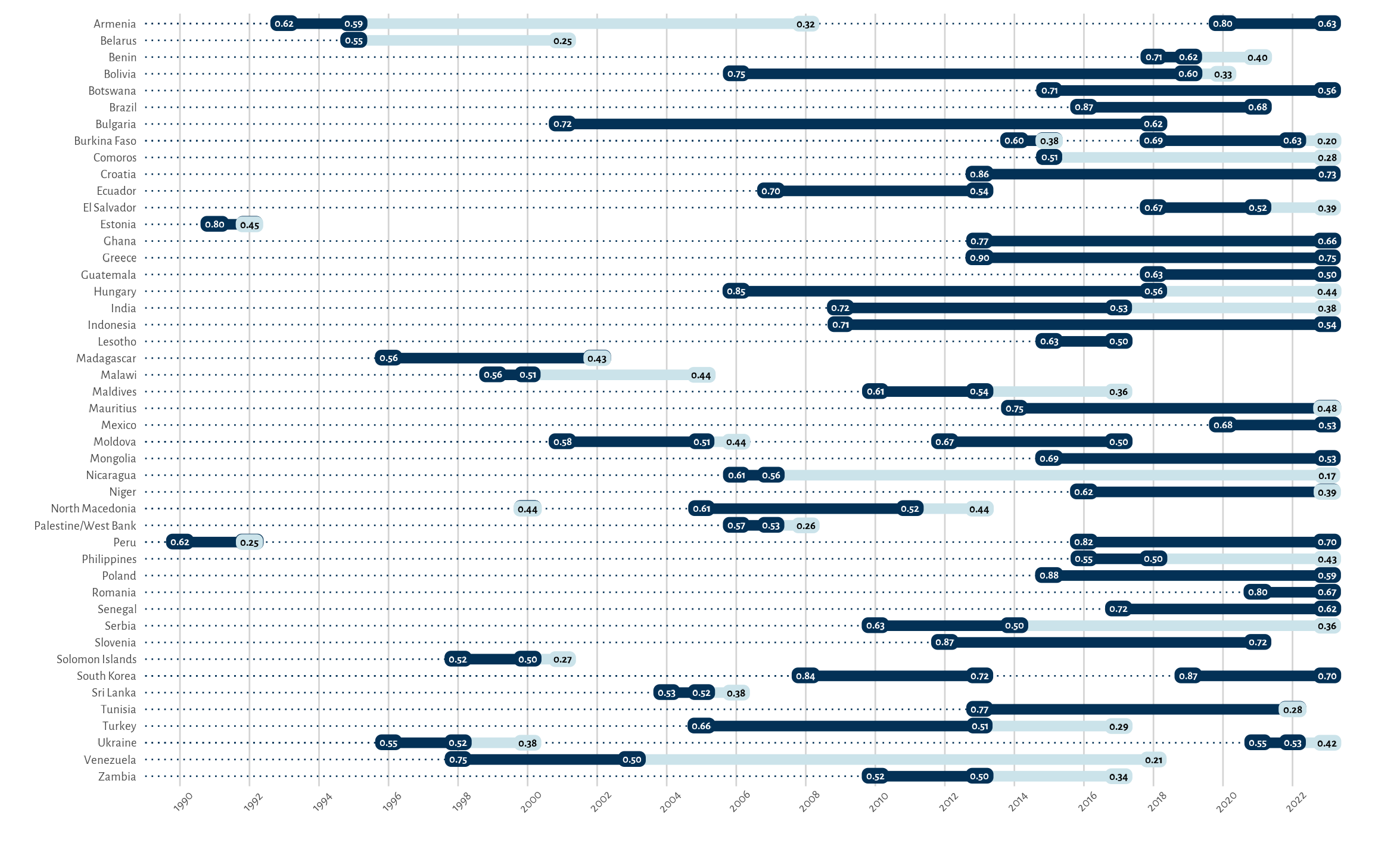
Figure 2: All episodes of incumbent-led autocratisation, between 1990 and 2024. The dark-shaded time-periods show when democratic recession occurred, but the country remained democratic. The light-shaded time-periods show when democracies break down into autocracies. The numbers denote the electoral democracy score at the beginning of an episode, in the year of democratic breakdown (when applicable), and at the end of the episode. The score runs from 0 (not at all democratic) to 1 (fully democratic).
The seven modes of incumbent-led democratic recession
Our research results in seven different modes of incumbent-led democratic recession: evasion, manipulation, infiltration, duplication, restriction, prohibition, and delegitimation. All autocratic actions we found can be classed into one of these modes, and target either democratic institutions, behaviours or values.
Targeting democratic institutions
There are four modes of autocratic actions that target democratic institutions: evasion, manipulation, infiltration, and duplication. The result of these autocratic actions is that the institutions that are designed and meant to ‘make democracy work’ (including critical opposition) are undermined, harmed, or otherwise made less effective. These include (parts of) the legislature, the judiciary, but also the media and civil society.
Evasion is the process by which existing rules are reinterpreted or circumvented to evade accountability and opposition. The ‘rules of the game’ remain the same and appear to be followed at least to the letter (if not in spirit), but the would-be autocrat employs procedural tricks to delay a critical debate (India in 2018) or conversely fast-track legislation to remove the opportunity for meaningful opposition (Hungary in 2017). But evasion is not limited to the legislature: it can also affect the judiciary by reassigning cases to more favourable courts or judges (Poland and Hungary throughout the 2010s). And it can affect the media by preventing journalists from attending press conferences (Ghana in the 2010s) or reducing the number of media licences (Greece in 2016).
Manipulation, in turn, concerns the active changing of rules, regulations and procedures to favour the incumbent. Again, this is often done in accordance with established procedures, following the ‘rules of the game’, but the outcome is an unlevel playing field. Aiming to extend or overstep presidential term limits is one common example (Venezuela in 2009; Burkina Faso in 2014). Other examples include the changing of electoral codes to benefit the ruling party (Macedonia in 2011) or gerrymandering. More covert manipulation can take the form of rules on how public money can be spent on government advertising, which if this income is crucial for media, leaves them open to political influence (Serbia in 2015).
Infiltration occurs when would-be autocrats appoint loyalists to institutions that are supposed to be neutral, critical, and independent. Infiltration is rather ambiguous, as many systems allow for the explicit political appointment of judges or ombudspersons. Yet when it becomes a persistent theme that appointments curtail the independent functioning or when an appointee’s career and livelihood depend entirely on compliance with the incumbent government, it is clear how it negatively affects the functioning of democratic institutions. Court-packing, for example, is a clear trend during incumbent-led autocratisation, but infiltration is not limited to the judiciary. In some instances, the hiring-and-firing organisation for the national level bureaucracy was infiltrated, ultimately potentially affecting the full bureaucracy (Slovenia in the 2010s); the Electoral Commission charged with organising free and fair election was infiltrated (Peru in the 1990s); or the leadership of public broadcasting organisations was replaced (Croatia in 2016).
Duplication is the copy and pasting of institutions that already exist into a duplicate. The original is then defunded, removed, or simply ignored, while the duplicate is presented to be the new, legitimate, and ‘true’ institution. At the national level, would-be autocrats can create a new judicial committee (even though the ‘old’ one still exists, as in Hungary in 2010) or a new financial organisation that takes over the role of a formerly independent commission (India in 2014). At the grassroots level, would-be autocrats can ‘astroturf’: creating new NGOs (Armenia in the 1990s) or a journalistic organisation (Croatia in 2015) that appear to emerge bottom-up but are actually controlled by the incumbent.
Targeting democratic behaviour
There are two modes of autocratic actions that target democratic behaviour: restriction and prohibition. The effect of these autocratic actions is that healthy and arguably even necessary behaviour for a democracy (such as protesting, voicing dissent, issuing critical advice) is made more difficult. As with the modes that target democratic institutions, this occurs throughout all layers of political life.
Restriction occurs when the would-be autocrat aims to increase the ‘cost’ of behaviour they deem unacceptable, without formally forbidding it. Here we enter the realm of harassment and intimidation, for example by charging critical journalists with using false citizenship papers after they published about government corruption (Niger in 2017). Or, through financial regulations, criticism from universities (India in 2018) and NGOs (Sri Lanka in the 2000s) can be made more difficult – although not completely prohibited.
Prohibition is the formal limit on democratic behaviour, sometimes accompanied with new criminal legislation. This ranges from the explicit banning of demonstrations (Malawi in 2002) and the revoking of media licences (Venezuela in 2007) to the banning of parties and opposition politicians (Peru in 2016). Where restriction is comparatively ambiguous, prohibition is a clearer signal that autocratisation is ongoing, especially when it consistently targets the same groups.
Targeting democratic values
The last mode of autocratic actions, delegitimation, targets democratic values. By attacking the (democratic) credentials of opponents, would-be autocrats aim to exclude them from the debate as illegitimate, treasonous, fake, or criminal. By extension, any criticism they put forth is also automatically suspect. In some cases, the incumbent forces the opposition to self-delegitimise, by requiring media outlets to publish a reprimand by a government-controlled media council (Hungary in 2010). But in most cases, the incumbent simply calls into question the neutrality of the judiciary (Brazil in 2022) or starts a smear campaign against critical ombudspersons (Serbia in 2015). Delegitimation is especially hard to combat when the would-be autocrat has access to more resources (including some control over the media) and more tools to show that the opposition is, in fact, illegitimate (for example by publishing about pending criminal cases). Although delegitimation appears ‘softer’ than some of the other modes, it is important that it is understood as autocratisation, as it often prepares the way for more formal limitations on the functioning and countervailing power of democratic institutions, and makes resistance to autocratisation by these delegitimised actors more difficult, because it directly impacts (and limits) which actors and what arguments are considered ‘part of the democratic, legitimate, public debate’.
Main takeaways: What this means for a defence of democracy
Based on our research, there are three main takeaways for the defence of democracy against such incumbent-led democratic recession.
One: autocratic actions occur along a broad, diverse, and creative spectrum. There is not a single, clear, unambiguous instrument or pathway with which democracy is receded. Not all autocratic actions are equal, however: while duplication, for example, is comparatively unambiguous and clearly autocratic in many instances, evasion is much less clear-cut and easier to justify. This implies constant vigilance on the part of pro-democratic actors as well as a deep knowledge on their part of what constitute autocratic actions, to be able to recognise and counter them.
Two: autocratic actions target democratic institutions, democratic behaviour, and democratic values. Autocratisation is not only about undermining formal institutions. Our research shows that would-be autocrats also target democratic behaviour and delegitimise democratic values. This matters because it erodes the informal norms and political space that sustain democracy. When oppositions are silenced or delegitimated, democratic defence becomes harder. Recognising these other forms of democratic recessions is therefore crucial.
Three: autocratic actions affect all layers of political life, from the top-level executive decisions and procedures to grassroots-level discussions and mobilisation. This means that a defence of democracy cannot rely solely on institutional checks and balances. Civil society, media, and citizens play a vital role in countering these actions. Policy makers and watchdogs should therefore monitor not only constitutional and institutional changes but also shifts in public discourse and political freedoms.
For policy makers, the shopping list offers a practical resource to recognise early warning signs of democratic recession and to criticise autocratic proposals on their democratic merit – not on their potentially beneficial outcome.
This post is based on an article titled ‘The would-be autocrats’ toolkit: what do incumbents do when they undermine democracy?’, published in the European Political Science Review, accessible for free. If you are interested to hear more about the research conducted by the authors, and the implications for policy makers, please contact them and they will be happy to discuss this in greater depth.
About the authors
Dr Joep van Lit is a postdoctoral researcher of democracy and autocracy at Radboud University, Nijmegen. His research focuses on the resilience of democracies, especially against attempts to undermine democracy by democratically-elected incumbents.
Carolien van Ham is Professor of Empirical Political Science at Radboud University, Nijmegen. Her research investigates democratisation and autocratisation, with special attention towards electoral integrity and election fraud.
Pingback: A ‘shopping list of autocratic actions’: what would-be autocrats do to recede democracy | The Inquiring Mind