
The government’s House of Lords (Hereditary Peers) Bill reaches its report stage in the chamber this week – presenting a serious moment for possible amendments. Meg Russell argues that peers should amend the bill to place constraints on the Prime Minister’s ability to appoint unlimited numbers of members to the chamber. This level of unconstrained patronage power is inappropriate in a modern age, and brings the House of Lords and politics as a whole into disrepute. It drives the chamber’s ever-increasing size (now standing at over 850), which should be capped at no larger than the House of Commons. Public opinion overwhelmingly supports this change, and it has long been the settled view of the House of Lords. Another legislative vehicle to implement this essential change may not present itself for decades, so peers should seize the opportunity while they can.
This week the government’s House of Lords (Hereditary Peers) Bill enters its crucial report stage in the House of Lords. The earlier stages of the bill have already been reported on this blog – it passed through the Commons rapidly last year, and completed its Lords committee stage in April. The report stage is the time when the bill might be amended, and this post argues that it should be.
The bill as it stands delivers on just one aspect of the government’s agenda for Lords reform: to remove the remaining hereditary peers from the chamber. But many other important proposals for Lords reform remain on the table. The most crucial has been under discussion for many years, both in the House of Lords and outside: the unconstrained nature of prime ministerial appointments, which drive the chamber’s ever-increasing size. Now is the time finally to deal with these problems. This post summarises 10 reasons why.
1. Prime ministers can’t resist patronage, and the chamber gets ever larger
Starting with the basics, there are currently no constraints whatsoever (except the ‘court of public opinion’) on the number of appointments that the Prime Minister can make to the House of Lords. He or she can potentially appoint any number of people at any time. The record of some prime ministers has been better than others, but most cannot resist overusing this power. After the chamber’s last significant reform, when the majority of hereditary peers departed in 1999, it had 666 members. Today, it has over 850. As the graph illustrating this period shows, with a few exceptions (notably during Gordon Brown’s and Theresa May’s premierships), the chamber’s size has tended to grow consistently year-on-year. This is clearly unsustainable.
Size of the House of Lords 2000 – 30 June 2025
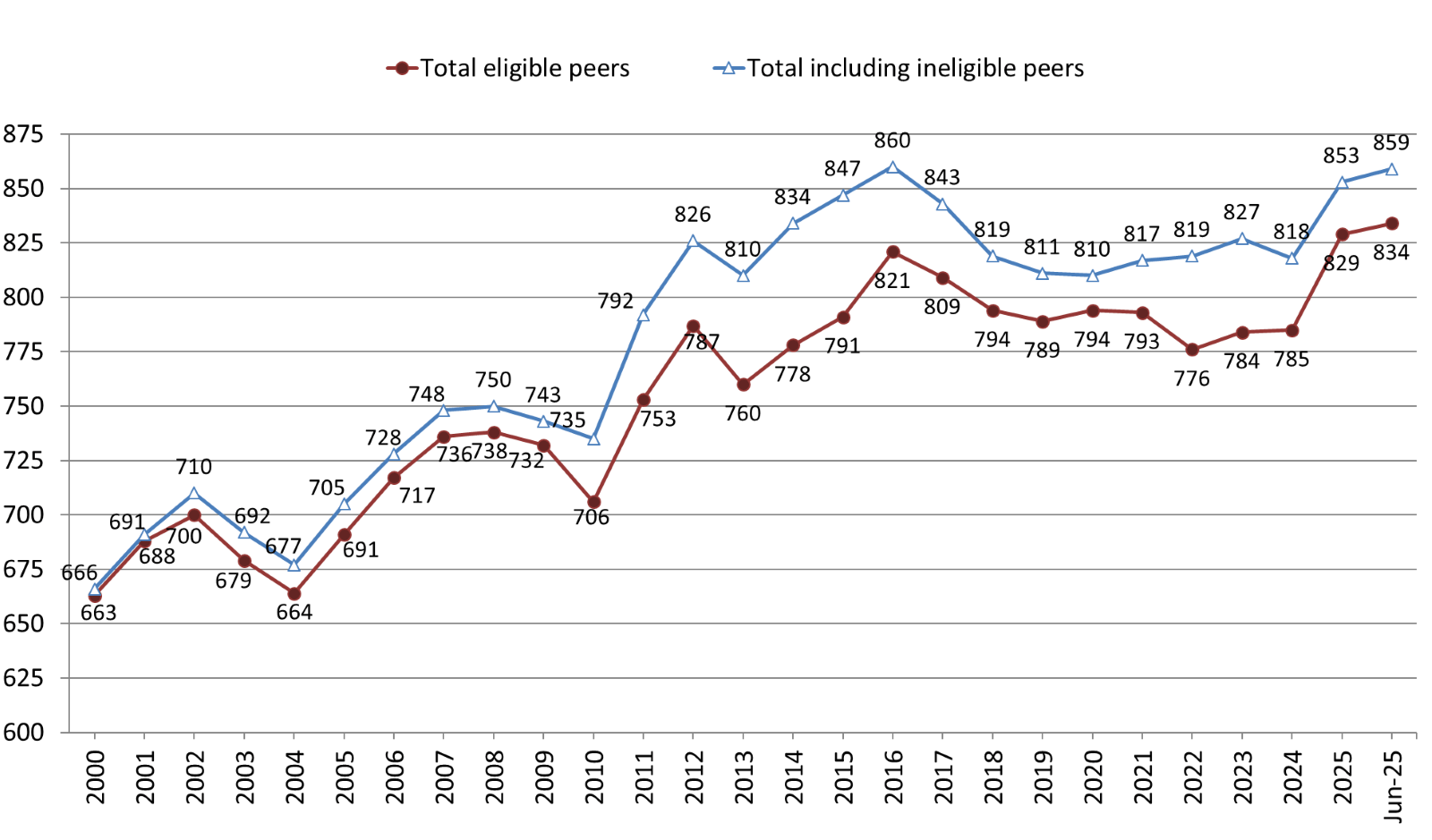
Source: House of Lords Information Office. All figures are for January unless otherwise stated.
2. The problem has been well understood for well over 20 years (indeed arguably for over 300)
More than 20 years ago, in 2003, Tony Blair’s Labour government published a white paper (pdf) proposing that the remaining hereditary peers should be removed, and the House of Lords managed down to no more than 600 members. This was never acted upon. In response to that white paper, the Constitution Unit published an analysis (pdf), showing that without constraints the size of the chamber would continue to spiral ever upwards – as it has subsequently proved to do. In 2011, following large numbers of appointments by Prime Minister David Cameron, the Unit published a report (pdf) supported by numerous cross-party figures (including former Conservative Lord Chancellor Lord (James) Mackay of Clashfern, former Labour Leader of the House Baroness (Margaret) Jay of Paddington, Crossbencher and future Lord Speaker Baroness (Frances) D’Souza, and former Commons Speaker Baroness (Betty) Boothroyd) calling for a moratorium on Lords appointments until agreement on a new system was reached. In 2015, the Unit published a further report modelling the size of the chamber under various appointment scenarios, showing how it could easily come to exceed 1000, or even 2000, peers. This helped to encourage the establishment of the Lord Speaker’s Committee on the Size of the House (which is discussed below).
But the problem of executive overappointment to the House of Lords did not begin in 1999, or even with the creation of life peerages in 1958. It also existed under the old hereditary system. Figures in the table below are compiled from the historical chapter of my 2013 book on the chamber:
| Year | Size of the House of Lords |
| 1603 | 81 |
| 1661 | 158 |
| 1719 | 220 |
| 1801 | 344 |
| 1837 | 433 |
| 1906 | 613 |
| 1952 | 789 |
| 1986 | 947 |
| 1999 (pre-reform) | 1210 |
| 1999 (post-reform) | 666 |
This demonstrates that the problem has existed for hundreds of years, and accelerates over time. Only in 1999 did the size of the chamber significantly drop, thanks to the removal of most hereditary peers. Overappointment was frequently controversial throughout this period. Indeed the first bill seeking to constrain the number of appointments to the House of Lords was proposed in 1719.
3. The problem cannot be fixed without legislation
Constraining the Prime Minister’s patronage power can only be achieved through legislation. While optimists have hoped for years that prime ministers might be persuaded to adopt self-restraint, this has repeatedly failed. The temptation to overuse patronage, to reward specific people or to gain party political advantage in the chamber, proves just too great.
There are various other ideas for incremental House of Lords reform. Notably, the 2024 Labour Party manifesto committed to introducing a retirement age, participation requirements, and tougher mechanisms for removing ‘disgraced’ members. Amendments were proposed on all of these matters at Lords committee stage of the current bill, but the government has suggested that they could be addressed without legislation. It is therefore urging peers to be patient, promising discussions after the bill has passed. But dealing with overappointment cannot be managed in this way.
Importantly, dealing with the size of the chamber also cannot be achieved only through these kinds of mechanisms to hasten departures; it requires restraints on how many can be added. This is illustrated by the fact that in the year since the July 2024 general election, approximately 80 new members have joined the House of Lords. This is already nearly enough to cancel out the number of hereditary peers departing.
4. Another legislative vehicle will not present itself any time soon
As emphasised in a previous blog post, legislative vehicles for House of Lords reform come around very rarely. This is the first government bill on the subject to reach the chamber for 26 years – since the House of Lords Act 1999. The last such bill before that had implemented a minor change 36 years earlier. There were multiple other government initiatives on Lords reform over this period, most of which failed. Some Private Members’ Bills have succeeded on minor matters, but they can easily be blocked – particularly if the government is hostile to them. Right now, the House of Lords has a legislative vehicle in front of it which is certain to pass. If peers want change, they should seize it.
5. This is the settled will of the House of Lords
Meanwhile it is well established that the House of Lords, on a cross-party basis, does want change. The chamber’s growing size and unlimited appointments have long been a major preoccupation. For example, at the launch of the Constitution Unit’s 2015 report indicated above, former Labour Chief Whip in the chamber Lord (Bruce) Grocott argued that the size of the chamber was ‘verging on the ridiculous and it needs to be dealt with’. In 2016, the Lords debated and unanimously agreed a motion ‘that this House believes that its size should be reduced, and methods should be explored by which this could be achieved’. Immediately afterwards, the cross-party Lord Speaker’s Committee on the Size of the House was established by Lord (Norman) Fowler (his two predecessors have also spoken out clearly on the problem). The committee, chaired by Crossbencher Lord (Terry) Burns, was charged with considering how the size of the chamber could be kept sustainable. It reported in 2017, recommending that the size of the House of Lords should be brought down to no larger than the House of Commons, and that once this was achieved future appointments should be made on a ‘one out, one in’ basis. Until the size target was reached, appointments should be on the basis of ‘two out, one in’. The committee’s report was debated in the House of Lords, and widely welcomed. It was also supported by the Commons Public Administration and Constitutional Affairs Committee (PACAC), which described ‘addressing the size of the Chamber… [as] an indispensable imperative’. The Burns committee continued to report regularly, sometimes with clear disappointment at the Prime Minister’s failure to show self-restraint.
6. It is also overwhelmingly supported by the public
Crucially, the public overwhelmingly supports this change. In 2022, a survey found that just 3% believed there should be no limit on the size of the House of Lords, while 65% believed that it should be no bigger than the House of Commons (amounting to an overwhelming 96% of respondents expressing a preference on the question). A brand new poll, published ahead of the report stage, reinforces these findings and goes further. Asked to choose whether the Prime Minister ‘should be able to decide how many new members are appointed each year, with no limit on the size of the chamber’ or ‘should be limited to appointing no more new members each year than the number who leave the chamber, so that its size doesn’t grow’ just 4% chose the status quo option, against 79% supporting change – amounting to 95% of those who expressed a preference (i.e. once respondents choosing ‘don’t know or can’t decide’ are excluded).
The same poll shows that support for limiting the Prime Minister’s appointments is substantially higher than that for removing the hereditary peers (which nonetheless has majority support, at 60%). Asked to choose between four options: simply removing the hereditary peers, doing so alongside placing limits on the Prime Minister’s patronage, introducing appointment limits while allowing the hereditary peers to stay, or doing neither, only 3% supported the first option – which is the government’s current position. The majority (56%) preferred a combination of removing the hereditary peers and placing a limit on the number of appointments, while 22% supported limits on appointments but retention of the hereditary peers. It might be said that the public wants the government to return to its 2003 white paper (see point 2 above).
7. Change is needed to constrain future prime ministers, not just this one
As already indicated, some prime ministers make more limited use of the patronage power than others (the number of appointments under Keir Starmer has already been relatively high, though this is not wholly unusual at the start of a parliament). But making this change is not just targeted at the present Prime Minister; it would deal with a historic problem and constrain any future Prime Minister who might not exercise self-restraint. Notably, an article in the May 2025 issue of Prospect magazine identified the unconstrained ability to ‘flood’ the House of Lords as a key risk in terms of ‘Why British democracy is vulnerable to a Trump-style takeover’.
8. The present system looks bizarre and outdated
Looked at objectively, the fact that a Prime Minister has unrestrained power to appoint people to one chamber of the legislature is really quite extraordinary in the modern age. Nothing similar exists in any other democracy around the world. It is also well known that the House of Lords is the only second chamber in the world to be larger than its respective first chamber (most are substantially smaller), and it is also the only one to have no size limit at all. While some second chambers include small numbers of members appointed by the executive (e.g. 11 in the Irish Senate, 12 in the Indian Council of States), mass appointment is unusual. The closest comparator is the wholly appointed Canadian Senate, whose size is limited at 105 members. Notably, since 2015, all new appointees in Canada have been independents, recommended to the Prime Minister by an Independent Advisory Committee for Senate Appointments. Allowing our Prime Minister potentially to manipulate the membership of parliament to the current extent is antiquated and democratically highly questionable.
9. By damaging the reputation of the Lords, and its ability to do its job, this situation damages politics as a whole
There are some differences of view regarding whether the size of the House of Lords matters for its functioning. Most (including most members) clearly believe that it does, though there are some dissenters. But what seems unquestionable is that the growing size of the chamber, and the Prime Minister’s unconstrained patronage power, are hugely reputationally damaging. This has been shown in media analysis, with growing numbers of headlines describing the chamber as ‘bloated’, and bemoaning peerage appointments. In debate on the Burns report in 2017, Baroness (Betty) Boothroyd suggested that the chamber’s ‘inflated size fosters our laughing-stock image’. This is clearly very damaging for public trust in parliament, and the House of Lords – making it harder for the chamber’s proposals to be taken seriously, and weakening parliament as a whole. It risks fuelling declining overall trust in the political system.
10. A Lords amendment would be straightforward and would in no way jeopardise the rest of the bill
At the committee stage of the bill in the House of Lords, Lord Burns proposed an amendment to implement this core recommendation from his committee. A similar amendment will be debated at the report stage. Peers must now choose whether they want to support it, in order finally to make progress on this issue that has so preoccupied them, and the wider public, for many years. In a rational world, the government would embrace the change – Labour’s manifesto commented firmly that the House of Lords ‘has become much too big’. But in practice governments rarely welcome constraints on their patronage power. If the amendment passed against the government’s wishes, ministers would need to decide whether to ask MPs to overturn the position supported by the 95% of voters expressing a preference, in favour of that supported by the 5%. Critically, passing such an amendment would in no way imperil the remainder of the bill. Governments are frequently defeated in the House of Lords. If MPs subsequently reject the Lords’ position the debate generally ends there, allowing the bill to pass.
A fundamental role of the House of Lords is to encourage the government and House of Commons to think again. It would be strange if on this matter, that peers have considered so carefully, and on which they are so in step with the public, they did not do so.
About the author
Meg Russell FBA is Professor of British and Comparative Politics at UCL and Director of the Constitution Unit.
Featured image credit: House of Lords chamber (CC BY-NC-ND 2.0) by ukhouseoflords.
Pingback: House of Lords Reform – Undergraduate Laws Blog
Pingback: The Constitution Unit blog in 2025: a review of the last 12 months of constitutional analysis | The Constitution Unit Blog
Pingback: The Guardian view on Labour’s new peerages: another boost for the ermine arms race | Editorial » nytimes
Pingback: The Guardian's view on Labour's new peerage: Another boost to the ermine arms race | Editorial - USA Daily Trends
Pingback: 노동당의 새로운 동료들에 대한 가디언의 견해: 담비 군비 경쟁의 또 다른 촉진 | 사설 - 9uam News – Trusted World News & Daily Updates
Pingback: The Guardian view on Labour’s new peerages: another boost for the ermine arms race | Editorial - Just Deploy It!
Pingback: La opinión de The Guardian sobre los nuevos nobles laboristas: un nuevo impulso para la carrera armamentista del armiño | Editorial | Sí, Se Puede
Pingback: లేబర్ యొక్క కొత్త పీరేజ్లపై గార్డియన్ వ్యూ: ermine ఆయుధ పోటీకి మరో ప్రోత్సాహం | సంపాదకీయం – Andhra News Toda
Pingback: Anonymous
Pingback: Anonymous
Pingback: లేబర్ యొక్క కొత్త పీరేజ్లపై గార్డియన్ వ్యూ: ermine ఆయుధ పోటీకి మరో ప్రోత్సాహం | సంపాదకీయం – SUJOY IT
Pingback: Labour’s Constitutional Agenda in Office: Constitution Unit Conference 2025 | The Constitution Unit Blog
Pingback: 10 reasons why the hereditary peers bill should be amended to constrain Prime Ministerial patronage and the size of the House of Lords | The Inquiring Mind