Project launch: the role of special advisers

PRESS NOTICE

Thursday 3 May: for immediate release

The Constitution Unit launches a new project on the role of special advisers (Spads) to ministers. Are they sufficiently accountable? And are they making government more responsive?

The recent resignation of Adam Smith, Culture Secretary Jeremy Hunt’s special adviser, raises important issues not just about the accountability of special advisers, but what their role in government is, say researchers at UCL’s respected Constitution Unit.

The Unit has begun a 15 month long project examining the issue of special advisers. It will ask some basic questions, which have rarely been asked: who are special advisers, what do they, and why it is that ministers regard special advisers as a vital resource?

Professor Robert Hazell, Director of the Constitution Unit, says: ‘The resignation of Adam Smith has raised questions about the accountability of special advisers: to whom are they responsible? And what is the appropriate role of the minister under which they work? These questions are not new and they will continue to be asked. Special advisers have now become a fixture in Whitehall, and so we need to ask some more fundamental questions. The role of special advisers is little understood: special advisers are seen as spin doctors, politicians in waiting, or wielding an inappropriate amount of power.’

Dr Ben Yong, lead researcher on the special advisers project, adds: ‘Leaving aside the current controversies over accountability, spads are here to stay. The number of spads has increased under the Coalition from 66 in 2010 to 83 in 2012. That is more than Gordon Brown ever had, and almost as many as Tony Blair had in his heyday. Accountability is important, but we also need to start asking questions about who spads are, what they do, and why ministers continue to appoint them.’

The project will examine the 350-odd special advisers in the period 1997-2012, looking at their history prior to government, and their activity following their time in government. This will also include interviews with former and current special advisers, their ministers and the civil servants who had contact with them. The aim is to ask not just how special advisers can be held accountable, but also how they can made more effective.

This project is funded by the Joseph Rowntree Charitable Trust. Ongoing updates on the project will available here:


Notes for editors

  • Robert Hazell is Professor of British Politics and Government and Director of the Constitution Unit. He is available for interview: contact r.hazell@ucl.ac.uk
  • Dr Ben Yong is a research associate at the Constitution Unit. He is available for interview: contact b.yong@ucl.ac.uk

Unit in the News: Clegg appoints new Spads

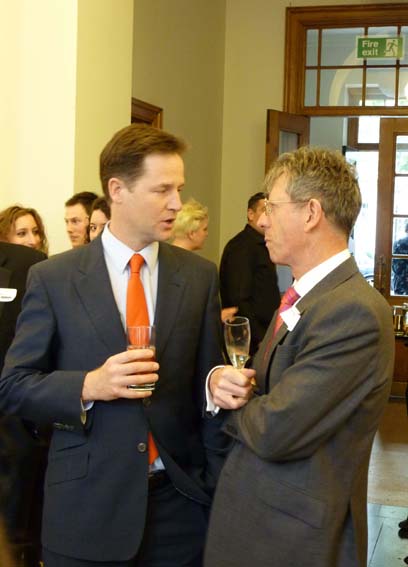
Nick Clegg & Robert HazellFollowing recommendations in our report into coalition government, the Deputy Prime Minister has announced new Liberal Democrat advisors will be placed in government departments.

The report, by Prof Robert Hazell and Dr Ben Yong, suggested that the Liberal Democrats have spread themselves too thinly and require additional resources to extend their influence, including more special advisers, expanded Private Offices, and additional support for the parliamentary party.

The report is part of a one-year project into monitoring the new coalition government in the UK sponsored by the Nuffield Foundation.

Media:

Further information:

Spads: Who they are, what they do, why they exist—and why they will continue to be appointed

What are spads, said everywoman, and would not stay for answer. Everyone knows about certain notorious special advisers—Alastair Campbell, spin doctor extraordinaire; Damien McBride, attack dog for Gordon Brown; and Jo Moore, forever infamous for sending an email around on 11 September 2001 saying, “today is a good day for burying bad news.”[1] Under the Cameron-Clegg administration, media reports on the whole remain fairly hostile.

There have been some dissenting voices, calling for more spads. Jahan Ganesh in Prospect (££); Tim Montgomerie on ConservativeHome; our esteemed (and rather more flush) colleagues at the Institute for Government as well. The recent reconfiguration of No 10’s policy unit suggests the coalition is feeling the absence of spads.

But what are special advisers, and what exactly do they do? There is surprisingly little on this, academically.

A technical definition: they are temporary civil servants, drawn from outside the traditional civil service structure, and subject to the patronage of ministers for whom they work. In layman terms, civil servants are appointed through open competition and promoted by merit. Special advisers, on the other hand, are appointed personally by ministers, to work for those ministers; when a minister leaves, the spad leaves with them. They may or may not have policy expertise.

What do spads do? Most think of them as spin doctors, but this is too crude. Maria Maley, at the Australian National University, has identified five basic functions:

  1. Personal support: managing the minister’s time, determining priorities
  2. Political support: in parliament, within the party, etc
  3. Communication: media management, but also management of relations with other key actors
  4. Policy matters: initiatives, development, implementation
  5. Executive coordination: between portfolios and between ministries.

The focus has always been on ‘spin’, but the truth is we don’t know what the majority of spads do. Some clearly are spin doctors (Alastair Campbell), but others are not (Jonathan Powell’s key ‘function’ would have been executive coordination; Andrew Adonis perhaps for his policy knowledge). There are usually about 75 spads in any one year: we tend only to hear about a tiny few, usually those at the centre; not those in departments.

Spads are often thought of as bright young things with an eye to a political post in the future. They are often thought to be former parliamentary researchers or think tankers. Former special advisers include David Cameron, George Osborne, Ed Miliband, Ed Balls, Jack Straw … the list goes on. But again: we don’t know if the labels ‘bright young thing’/ ‘political careerist’ are appropriate because no one yet has studied them in detail in the UK (see below for the exceptions).

A final point, before this post gets too long. The focus has always been on spads, and their apparent malign influence—but there is a prior question: why do ministers keep appointing spads? Well—again, we don’t know the actual reasons. But we can guess. Spads exist because there is a demand for them. And there are at least three reasons why ministers may want to appoint spads:

  1. Ministers are overloaded.[2] They just have too much to do—so spads help ministers to determine their priorities.
  2. being (ostensibly) neutral, civil servants cannot offer ‘political’ advice; spads, often being appointed for their political qualities, can.
  3. Ministers want to increase the ‘responsiveness’ of the civil service, which is seen as passive and obstructive; spads can drive the machine because they exist outside the civil service.

There may be a fourth reason: coalition government. Coalition government may require greater negotiation between parties; spads may provide that liaison function.

Whether or not these reasons are legitimate reasons is another story. But these are likely to be the reasons ministers will give in appointing special advisers. We should be asking ministers what they think special advisers are for, and to what extent they fulfil this function (or functions). It is time we moved on from talking about spads in a largely negative manner and asking whether there are too many, to asking why are they there, how they contribute, and whether they can improve ministerial effectiveness.

Background

The Constitution Unit has been working on a grant proposal on special advisers, and so it seemed appropriate to blog on this. For those really interested in spads, there is Andrew Blick’s excellent text. On the internet, start with the House of Commons’ library research note; or  the Public Administration Select Committee’s 2001 report, Special Advisers: Boon or Bane, which is still good value. There’s also an excellent article by a former spad to Jack Straw here, which gives an insight into a spad’s everyday life. The Powerbase website has (very) uneven coverage of special advisers. On what ministers do, and ought to do, there is the (so-so) Public Administration Select Committee report What Do Ministers Do?

EDIT 14/04/11: a very interesting report on the coalition’s spads here:

http://network.civilservicelive.com/pg/pages/view/564295/

EDIT 16/09/12: I should have updated this long ago. But the Unit is now carrying out a project looking at special advisers 1997-2012. Watch for more news here:

http://www.ucl.ac.uk/constitution-unit/research/special-advisers


[1] And of course Sir Richard Mottram’s rather choice response when he discovered Jo Moore’s email had been leaked.

[2] I could write a whole post on this. Ministers have ridiculous workloads. This is partly because of the complexity of modern government; and partly because of an unwillingness to define what a minister ought to do.