Yesterday, Calixte Bloquet and Ruxandra Serban published a post explaining why the French National Assembly decided to trial a weekly session of Prime Minister’s Questions. Here they explain how the experiment fared and why it failed.
What did French PMQs look like?
To investigate how the new PMQs procedure operated in France, we looked at every question asked to the Prime Minister on Wednesday sessions during the six weeks prior to the experiment, as well as the six weeks of the experiment. For each question, we coded the author, as well as their party and position (majority or opposition). We also coded the theme of each question, and whether it had a conflictual tone. Finally, we coded whether the questioner answered and/or posed a second question in their allotted time. This tends to be correlated with adversarialism: if the questioner leaves some time from their allotted 2 minutes, this is usually a sign that they want a chance to criticise the answer. One of the six sessions of the experiment did not take place (22 May), and out of the Wednesday sessions we selected prior to the experiment, the Prime Minister was asked questions on five out of six sessions, but on one of these occasions, the question was answered by another minister, leaving four Wednesdays when the Prime Minister answered a question in the Assembly.
What is immediately apparent when looking at how the procedure has changed the way questioning takes place in the National Assembly is, on the one hand, the increase in the number of questions and, on the other, the greater diversity of questioners (Table 1). Indeed, before the procedure was introduced, the Prime Minister rarely answered questions – seven in the six sessions before the new procedure, against 10 per session with the new procedure, amounting to 50 questions in total during the experiment. In terms of who gets to ask questions, five of the seven questions asked before the new procedure were asked by a party leader, compared to only two of the 50 questions asked during the experimental sessions: a much more diverse group of backbenchers are directly involved in the questioning, democratising the questioning of the Prime Minister. Interestingly, the two questions asked by party leaders under the new procedure were both asked by leaders of governing parties, which could be interpreted as a sign of respect for the Prime Minister. As far as the parties are concerned, the procedure dictates the results, as each party is allowed to ask one question per session, regardless of its size.
Table 1: Distribution and conflictuality of questions to the PM, under conditions of collective and individual questioning
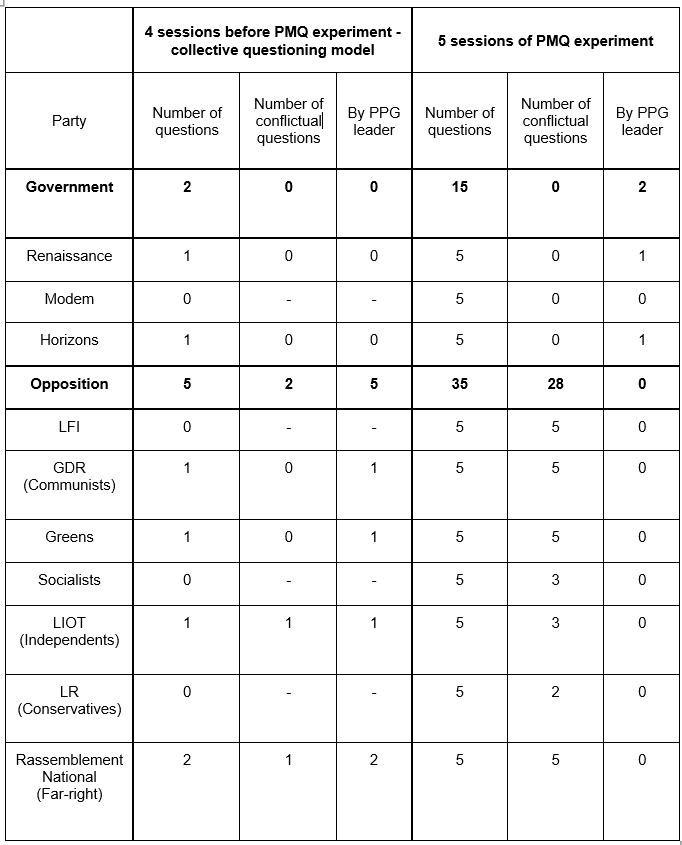
These questions are clearly used differently by parties in government compared to those in opposition, but the change in procedure did not seem to affect these patterns. Not a single question asked by a member of a government party, under either procedure, showed signs of being conflictual, either in tone or because the MP used their right to reply. Meanwhile, of the 35 questions asked over the period by opposition parties, only seven were neither confrontational in tone nor used the opportunity to reply; the distribution falls along expected government-opposition lines.
In terms of the topics of questions, there seems to be no clear pattern: the Prime Minister was asked about many different subjects, from industrial policy to the Olympics, and from education to international relations. This may be a slight change from previous patterns, when the Prime Minister was usually questioned mainly by party leaders.
Why was the new PMQs procedure not adopted permanently?
The dissolution announced by President Emmanuel Macron on 9 June 2024 did not allow the evaluation of this new procedure to take place in mid-June as planned, as the Assembly was dismissed and new elections had to be organised. The newly elected Bureau of the National Assembly, the collegiate organ in charge of the internal organisation of the chamber, had to draw its conclusions after the appointment of the new government in September.
The Bureau decided to revert to the previous procedure. The reasons given were succinct: the goals of increasing participation and interest had not been achieved and the party leaders had ‘no attachment’ to the process. Michel Barnier, the newly appointed Prime Minister, also had no interest in it. Another argument that may have played a role is the shift in majorities: the party groups opposed to the procedure have become larger because of the election, while the groups in favour of the procedure have tended to become smaller, so that support has become narrower.
The reform therefore failed because of a lack of political support and bad timing – both of which are crucial for the outcome of any attempt at parliamentary reform. As the experiment only ran for a short time, it is hard to say what it could have become in the long run.
Its failure is not devoid of interesting features: indeed, it is worth noting that this instrument, which was advocated as an attempt to give MPs more control over the government, was rejected by large sections of the opposition, even though it is they who have the most to gain from strict scrutiny of the government. On the contrary, they seem to have seen this change as a reduction of their oversight abilities – as they have fewer opportunities to ask questions to the minister actually in charge of a given topic – and a way for the majority parties (Renaissance, MoDem and Horizons) to use the question time as a political stage. This contrasts with how questions to the Prime Minister are generally perceived in Westminster-type parliaments, so what explains it?
One hypothesis to explain this difference may lie in the difference in status between the French Prime Minister and the classical position of a prime minister in a Westminster-style parliamentary system. Unlike the British Prime Minister, the French Prime Minister is not (usually) the keystone of the executive. They are not the leader of the party or the ultimate decision-maker: that is usually the President. In these configurations, the Prime Minister is generally the coordinator of government action, whose quality is measured by their ability to stand back and allow the absence of crises to speak for their competence. In any case, this is the role that most prime ministers have played in recent decades, alongside presidents who are decision-makers as well as the identified face of the executive. Questioning the Prime Minister is therefore not questioning the decision-maker, but rather questioning a second fiddle.
However, the political landscape in France has changed since 2022, and the country has to get used to minority governments in which the Prime Minister is a more important but also more fragile figure, and to a context in which President Macron suffers from record unpopularity. Shifting the focus to the Prime Minister was always going to feel forced in the French Republic, but in this context, it could be seen as an attempt to bring out another, perhaps more popular, leader into a governing coalition that can no longer rely on the popularity of the President, and to give credibility to a position that is institutionally incredibly fragile. In this light, the opposition’s rejection – and the majority party’s insistence that this experiment should take place during an election campaign – makes sense. The goal was not to enable oversight, but to create political capital and credibility.
Conclusion
This short-lived experiment illustrates the complex politics of parliamentary reform: although the stated intention was to improve parliamentary oversight of the head of government, opposition MPs rejected this premise and saw it as a move to increase the Prime Minister’s status, whilst coalition parties thought that more productive scrutiny is carried out by questioning ministers. Although the experimental procedure led to questions on a wider range of topics and by more backbench MPs, it is debatable whether in the French context this actually means meaningful and relevant scrutiny, given the Prime Minister is neither the key executive figure, nor a minister with a clear policy portfolio. Without a clear role within the French constitutional structure that would justify gathering political support for PMQs, it looks unlikely that this experiment will be repeated in the future.
Interestingly, another session of Prime Minister’s Questions was organised in December 2024. The context was very specific: the new Prime Minister, Francois Bayrou, had just been appointed, but the ministers of his government were not yet in place – and the constitution mandates a weekly session of questions be held for a parliamentary week to be valid. Outside of other real options, the procedure that was used under Gabriel Attal was therefore a very convenient tool for the government to have. To the detriment, yet again, of the quality of parliamentary oversight.
This is the second post in a two-part series on the recent trial of Prime Minister’s Questions in the National Assembly. The first post in the series, which explains why this experiment was attempted, was published yesterday.
About the authors
Calixte Bloquet is a research associate at the Institute for Parliamentary Research (IParl – Berlin) and an associate member of the CESSP (Paris).
Ruxandra Serban is a Lecturer (Teaching) in Comparative Politics in the Department of Political Science at UCL.
Featured image: Richard Ferrand – Assemblée nationale (CC BY 2.0) by paquierjacques.
Pingback: The Constitution Unit blog in 2025: a review of the last 12 months of constitutional analysis | The Constitution Unit Blog