
The Labour government has pledged to remove the remaining hereditary peers from the House of Lords. With a bill to do so now in the Commons, Lisa James looks at the profiles of the sitting hereditary peers and asks how their removal might impact the second chamber.
The remaining hereditary peers will soon be removed from the House of Lords. The reform featured in the Labour manifesto and the new government’s first King’s speech; a short bill has recently been introduced into the House of Commons and will be debated later in the autumn. It will see the remaining hereditary peers removed at the end of the current session of parliament.
The reasons to remove the remaining hereditary peers include important normative ones, resting on the inappropriateness of hereditary status as a qualification to sit in parliament in a modern democracy. This normative argument is widely (if not universally) considered settled. Alongside principle sit political motives; the majority of hereditaries are Conservative (and only four are Labour). And in practical terms, their removal will reduce the size of the House, which is widely considered too large. This post focuses on the effects of the proposed change, asking how the removal of the hereditaries will affect the composition of the second chamber.
Background
The removal of the remaining hereditaries constitutes unfinished business from 25 years ago. For centuries the House of Lords was – excepting the bishops, and latterly the Law Lords – a hereditary body, with new peerages as a matter of course being created as hereditary titles. This changed in 1958, with the passage of the Life Peerages Act. Further fundamental reform followed in 1999, when Tony Blair’s Labour government removed the majority of hereditary peers from the chamber. The bill originally sought to remove all the hereditary peers, but this proved contentious in the Lords itself, and a compromise was brokered to allow it to pass. Thus 92 hereditary seats were retained (and a small number of other hereditary members were given life peerages). It is these final 92 seats which are now set to be abolished.
The remaining hereditaries are, counterintuitively, the only elected members of the House of Lords. Three different systems operate, according to the compromise reached in 1999. Two seats are reserved for the holders of roles linked to the royal family; 15 are chosen in elections by the whole of the House of Lords; and the remaining 75 are elected by the sitting hereditaries within the relevant party group. Among the latter by-elections, there have famously sometimes been more candidates than voters.
By-elections were paused via an amendment to the Standing Orders soon after this year’s King’s speech, in anticipation of the bill to remove the hereditaries, which was introduced to the Commons on 5 September. With a handful of seats currently vacant, there are now 88 hereditary peers sitting in the House of Lords.
Titles
It is easy to assume that hereditary peers all hold ancient titles. But given that it was not possible to award life peerages until 1958, many hereditary titles are far more recent. Among the current hereditaries there are almost as many titles originating in the 20th century as in the previous centuries combined. Consequently 24 current members are either only second- or third-generation title-holders.
The oldest title dates to 1299; held by Lord de Clifford, it was created for a prominent soldier. The most recent, held by Lord Inglewood, post-dates the Life Peerages Act and was created for his father William Fletcher-Vane, a Conservative MP and junior minister, in 1964. Between the two lie peerages created for courtiers, colonial administrators, Victorian Cabinet ministers, and numerous twentieth century MPs and businessmen. Perhaps the highest-profile of these are the titles created for former Prime Ministers: Labour Prime Minister Clement Attlee’s grandson now sits on the Conservative benches, while Crossbencher the Earl of Oxford and Asquith is the descendent of Liberal Prime Minister Herbert Asquith.
| Century created | Number of current hereditary members | Percentage |
| 20th | 43 | 49% |
| 19th | 20 | 23% |
| 18th | 7 | 8% |
| 17th | 7 | 8% |
| 16th | 4 | 5% |
| 15th | 4 | 5% |
| 14th | 2 | 2% |
| 13th | 1 | 1% |
| Total | 88 | 100% |
Party balance
The most obvious immediate impact of removing the hereditaries will be on the size of the House. The chamber’s membership will fall from its current level of 806 eligible peers (i.e. excluding all those on leave of absence, suspended or disqualified) to 718 – a reduction of around 11%. The growing size of the Lords has been a widely-noted problem, but this reduction will have a lasting effect only if the new Prime Minister and his successors ensure the numbers do not simply rise again through the creation of more life peers.
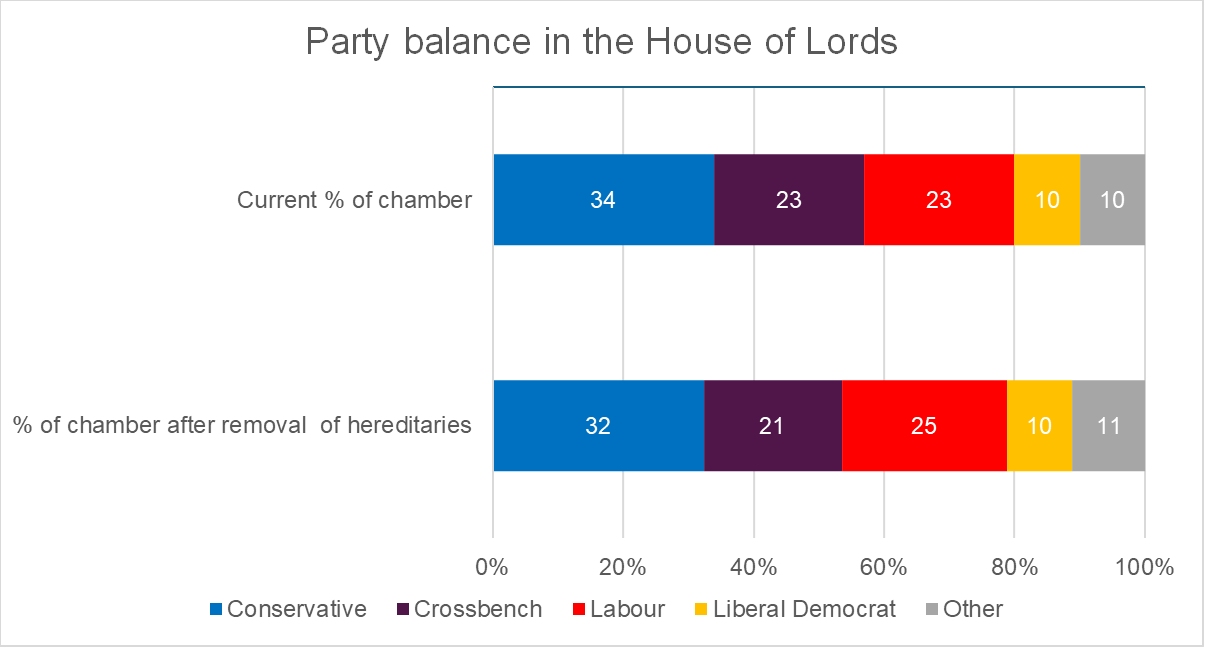
An obvious question is the effect the removal of the hereditaries will have on party composition. The hereditary peers are majority Conservative (45 out of 88), alongside 33 Crossbenchers, four Labour and four Liberal Democrat peers, and two non-affiliated.
However, the overall impact on party balance in the Lords will be relatively small – largely because the Conservative group is so large. It is the Crossbenchers who stand to lose the greatest proportion of their number (at 18% compared to the Conservatives’ 16%). The proportion of Labour peers will rise slightly, and the proportions of Conservatives and Crossbenchers fall slightly, but these changes are not large.
Demography
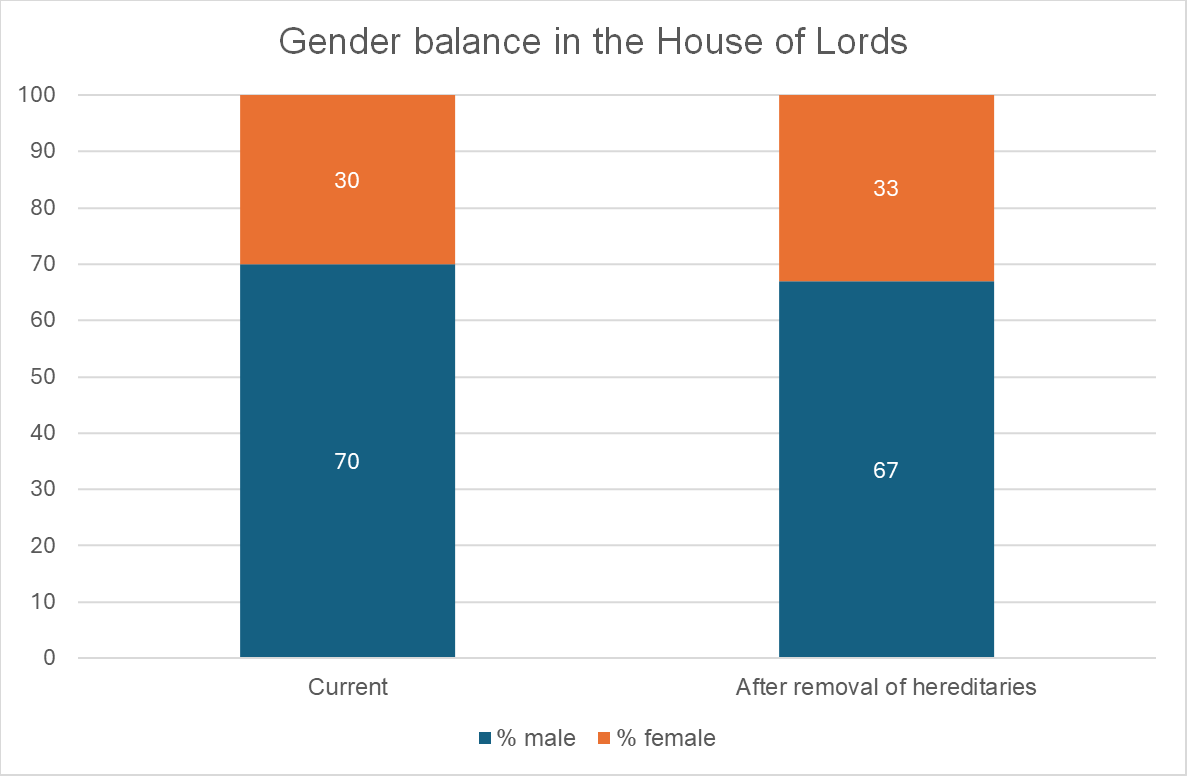
The most obvious demographic consequence of removing the hereditaries will be on gender balance in the Lords. The current hereditaries are all male; only a small number of peerages can be inherited by women, and the last female hereditary, the Countess of Mar, retired in 2020. Their removal will decrease the proportion of male peers from 70% to 67%.
The consequences for age are harder to calculate, as not all peers make their birthdate publicly available. The House of Lords Library calculates the average age for peers overall at 71; available data on the ages of the hereditaries suggests that as a group they are only slightly younger, with an average age of 69.
Experience
Of the 88 hereditaries currently in the Lords, 33 have served continuously since before the 1999 reforms. A further 15 of those elected since that date are returning peers, who lost their seats in 1999 and have since won them back through the by-election system.
Even leaving aside the returning peers’ additional experience pre-1999, the current hereditaries have on average more years’ experience in the Lords than life peers, who tend to be appointed relatively late in their careers, with significant experience outside the chamber. Compared to an average of 14 years’ Lords experience for life peers, the average hereditary peer has served 21 years. Nonetheless, as the table below shows, the actual number of years’ experience varies widely across the group, with many recent entrants as well as some very long servers:
| Years’ experience in the House of Lords | Number of current hereditaries |
| 1-10 | 39 |
| 10-20 | 14 |
| 20-30 | 4 |
| 30-40 | 12 |
| 40-50 | 14 |
| 50-60 | 4 |
| 60+ | 1 |
| Total | 88 |
An obvious question is what the hereditaries have contributed during their time in the chamber, and what roles they might vacate which will need to be filled from among the life peers. As in 1999, a small number of the most active individuals might themselves be offered life peerages to allow them to continue contributing to the chamber.
More than two dozen of the hereditaries have experience as government or opposition frontbenchers – perhaps foremost among them is current Shadow Deputy Leader of the House of Lords, Lord Howe, who has been on the Conservative frontbench in the chamber in various guises since 1991.
The greatest number of new vacancies will be on the committee corridor, with 34 hereditaries currently serving on at least one select committee (including the new chair of the International Relations and Defence Committee, Lord De Mauley). Some have been high-profile contributors to the committee system. One example is Lord Kinnoull, who is former chair of the European Affairs/European Union Committee and a current or former member of various others.
The removal of the hereditaries could also open up roles in chamber and group leadership. Lord Kinnoull is the current Convenor of the Crossbench peers, and one of six hereditaries currently serving as a Deputy Speaker (the Lords has a far larger roster of Deputy Speakers than the Commons, with 20-25 at any one time).
Attendance and engagement
It might be expected that hereditary peers – who have actively campaigned for election, albeit within a small pool – would be more motivated to attend the House of Lords regularly than life peers. Headline figures seem to bear this out to some degree; the hereditary peers averaged 58% attendance in the 2023-24 session, compared to 52% overall.
However, there is little evidence that the hereditaries vote more often than their colleagues. Analysis of voting behaviour – based on Unit data on divisions in the Lords – shows that voting rates for the two groups are essentially the same: 52% for the hereditary peers and 53% for life peers. Rates of rebellion are slightly lower among the hereditaries who have taken a party whip than among corresponding life peers, but are negligible in both groups, hovering around the 1% mark.
Conclusion
A closer look at the departing hereditaries suggests that the overall practical effect on the chamber should not be overstated. The reduction in numbers will be noticeable (so long as it is not reversed by new appointments of life peers), but the effect on party balance will be fairly limited, and the Conservatives will remain the largest group. Any effect on participation and rebellion rates is also likely to be small. The Lords will become somewhat less male, marginally older, and slightly less experienced. Should Labour adopt the same tack as in 1999, and offer a small number of life peerages to some of the most significant contributors, these effects could be reduced yet further.
About the author
Lisa James is a Senior Research Fellow at the Constitution Unit.
Pingback: Public wants much greater Lords reform than government’s modest plan – new survey – We See & Show
Pingback: Public wants much greater Lords reform than government’s modest plan – new survey – Johansen.se
Pingback: Labour and the constitution: (almost) one year on | The Constitution Unit Blog
Pingback: The House of Lords (Hereditary Peers) Bill: the story so far | The Constitution Unit Blog
Pingback: The Guardian view on the House of Lords: ministers risk a hollow reform with a partisan approach | Editorial – seitoo
Pingback: The Guardian view on the House of Lords: ministers risk a hollow reform with a partisan approach | Editorial - DW TALKS
Pingback: The Guardian’s view on the House of Lords: Ministers risk hollow reform with partisan approach editorial – The First Info
Pingback: The Guardian view on the House of Lords: ministers risk a hollow reform with a partisan approach | Editorial – adsbyx
Pingback: The Constitution Unit blog in 2024: a guide to the last 12 months of constitutional analysis | The Constitution Unit Blog
Pingback: The truth about an archaic tradition Labour wants to abolish
Pingback: Labour’s removal of hereditary peers from the House of Lords: 10 key questions answered | The Constitution Unit Blog
Pingback: Week beginning 2 October 2024 – Robin's Room
Pingback: Britain is finally abolishing hereditary peers from the House of Lords – a constitutional expert on the historical reforms that built up to this moment – Johansen.se