Spads gone bad: public allegations of special adviser misconduct

The Constitution Unit has produced a brief research note, as part of our project on special advisers, on public allegations of misconduct from 1997 to 2013. Laid out below we present the key findings and thoughts on how such findings may subsequently shed light on these apparent creatures of  darkness.

As well as attempting to ascertain how special advisers function within government, a large concern of our current project is the means by which their effectiveness may be improved;  in order to understand how a special adviser may function without hindrance, it is crucial to examine the times at which special advisers may have been seen to have slipped up. A better idea of the types of behaviour by special advisers that have historically precipitated public scandal may take us some way in devising appropriate strategies to avoid common pitfalls of the job.

So what was found? For a start, we collected evidence of 26 separate cases where a special adviser had been publicly accused of specific behaviour constituting misconduct (between 1997 and 2013). Out of these 26 cases, 15 involved special advisers based in a department outside the centre of government, while less than half of cases involved those at No. 10, the Cabinet Office and the Treasury. We found that it is the special adviser more prone to media relations (media SpAds) who tend to have been on the receiving ends of accusations of misbehaviour. Furthermore,  in recent years there seems to have been an increase in the regularity of public accusations of special adviser misconduct – see below.
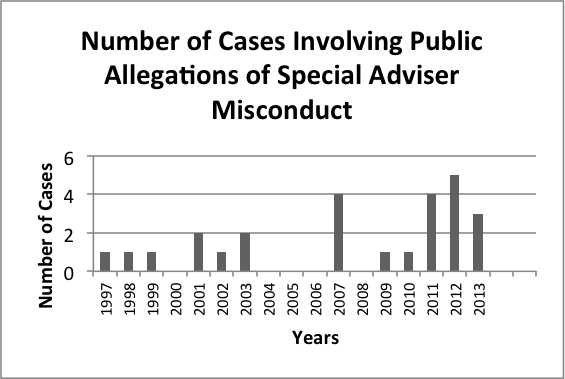
Spad graph

While there clearly has been a rise in the number of public allegations of misconduct, this does not necessarily hold any bearing on the extent to which the behaviour of special advisers might have changed for the worse. One potential explanatory factor of such an increase in cases may be due to intensified media coverage  – 24 hour news, the increasing prevalence of political blogging and the like.

In regards to situations where spads are faced with public criticism, it was circumstances in which some sort of personal attack was involved that were the most common. Another cause for criticism that seemingly tripped up many a spad was the use of government resources  for work considered party political; for example, using departmental e-mail addresses for party leadership campaigns.

What might these findings mean for special advisers? One thing that seems clear is that there is much more to be explored in relation to the interaction of the special adviser with the media. It is interesting that it is special advisers who deal with the media who are prone to accusations of bad behaviour – for example, some of the cases where special advisers had been accused of personal attacks were a direct result of feuds with specific journalists. What also might be looked into is the impact of the current format of regulation of special advisers. There are now at least four separate legal documents that special advisers are bound by. This means rather than their being subject to coherent, easy-to-understand limitations, special advisers are currently faced with a rather disjointed jumble of directions: not so easy-to-follow and more likely to provide scope for falling flat on one’s face.  The increasing lack of coherence when it comes to spad regulation may also help to explain the increase in the number of cases of alleged misconduct in the last few years.

The note can be read in full by clicking on the following link:
http://www.ucl.ac.uk/constitution-unit/research/special-advisers/special_advisers_and_public_allegations_of_misconduct_1997_-_2013.pdf

Ed Balls Ed Balls Ed Balls: Spad, Official or Both? The Joys of Research and Government Transparency

10th May 2013

It is occasionally suggested by Whitehall veterans that Ed Balls began as a spad and ended as a civil servant. We have no such evidence that this happened. The confusion seems to lie in the fact that the previous person with the title ‘Chief Economic Adviser’ was a civil servant—Sir Alan Budd), as is the current one (David Ramsden).

But in the period that Balls was ‘Chief Economic Adviser’ he was also a special adviser. He was clearly stated as such in parliamentary questions between 1997 and 2001.[1] The records are not clear for 2001-3 (Balls is not named in the records we have seen),[2] but the Chief Economic Adviser in this period is specified as a special adviser in Hansard. We’re presuming that person is still Ed Balls. So the story seems to be that Gordon Brown as Chancellor decided to appoint Balls to a role which was conventionally held by a civil servant or formal employment terms. But Balls remained a spad.[3] That is our understanding. But we would welcome—indeed, encourage—corrections.[4]

This is nerdy stuff, but it’s important. This is what research is all about: grappling with imperfect information. It’s assumed that everything in government is always perfectly recorded, but it is not. For instance, there is an expectation of regular, annual data releases on numbers and names of special advisers. And for the first two years of the Coalition numbers and names were released at regular intervals—roughly, every four months. There has not been a new release since October 2012—seven months.[5]

Does this matter? It matters to researchers like us. Imperfect or faulty information means we may make faulty inferences. So for instance the lack of up to date data on special advisers means it is difficult to determine tenure of spads with consistency. Data releases on spad numbers never talk about spads leaving, only entering government—so we have to infer from their absence that they have left.[6] Tenure is important because it would help us understand the nature of the work that spads do: for example, if tenure is short, it may suggest short-termism; if tenure is changing, it may suggest the nature of the job is changing.

But there is a deeper point here: government transparency.[7] Some people have already taken office in the period since October 2012 as special advisers, but they are not listed anywhere. Would it not be advisable to list their names and details so that people with relevant interests and concerns might be in contact with these advisers? More generally, if spad numbers have dropped or risen, that might also be useful so that the public to know, so that they can appraise the current government’s use of special advisers, and their numbers.


[1] See, eg., HC Deb 28 July 2000 vol 354 cc972-4W.

[2] See, eg., HC Deb 16 July 2003, cc328-9W. In fact there is generally very little Hansard coverage of special advisers in that period.

[3] Brown had a way of doing such things: he had a ‘Council of Economic Advisers’ which was for all intents and purposes simply another group of special advisers—if one looks at the annual data releases on special advisers, those ‘sitting’ on the Council of Economic advisers were included, oddly, as a footnote, as if to suggest they were not special advisers. Needless to say the Cabinet Office continues to follow this obfuscatory practice.

[4] Tweet us!

[5] To be exact: there was a (poorly edited) release on 19 October 2012—see Matt Honeyman’s spellbinding post on this. But there has since been a revised version of those special advisers employed as of October 19 2012 published 17 February 2013. But all that did was revise the earlier release: it does not tell us who was a spad as of 17 February 2013.

[6] Of course we can work this out in other ways, but they are less authoritative than government statements.

[7] Liz Fisher from Oxford University is similarly critical of the transparency agenda: see

http://ukconstitutionallaw.org/2013/05/09/liz-fisher-gov-uk/.

Times Campaign for New Breed of Mandarins Off-Target?

21st Febuary 2013

By David Laughrin, Honorary Senior Research Associate, UCL Constitution Unit and former Senior Civil Servant

A recent run of articles in The Times has intrigued me. The latest  shot is “New breed of experts takes on the mandarins” (20 February). This suggests that “Ministers have appointed a string of ‘expert advisers’ from outside Whitehall in a first step to politicise the Civil Service.”  Despite the rather small string described and the reported (and rather over-dramatic) alleged fears about politicisation, the accompanying Times leader suggests that “The American system, whereby whole administrations change upon election, has much to be said for it.” This echoes the thrust of a recent three day Times series.  But it ends with a less dramatic conclusion that bringing in expert advisers is a good thing provided their roles and responsibilities are made clear.

What all this unexpectedly prominent and not wholly coherent news coverage fails to make clear itself is that the process of bringing outsiders into Whitehall is not new. Some of us are old enough to remember the business team brought into Whitehall by Edward Heath under Sir Richard Meyjes[1] in the early 1970s, in an echo of those brought in by Churchill during the Second World War.  There have been lots of others since, some successful – like Sir Derek Rayner for Mrs Thatcher – and some less so. There has also been a large rise in external recruitment to the Senior Civil Service.

But more importantly the article also fails to address the central issue of how better decision-making in government is best encouraged. Is it by the kind of politicisation that The Times seems to want to promote, albeit a bit half-heartedly? Or is it, as I would argue, through policies that get the right blend between challenge and support, driving through necessary change while ensuring proper expert scrutiny and risk assessment?

Good decision-making in Government is not easy, and is probably often more difficult than in many private sector situations. (I have argued this more fully in a booklet called Searching for the X-Factors[2].) The best climate for good decisions seems to come from situations where right until late in the day there is provision for challenge – of pre-conceptions, of analysis, of evidence, of conclusions, of implementation plans.

As top decision-makers in the private sector said to me, we need people who can kick the tyres and properly stress-test proposed solutions. As Professor Philip Tetlock has suggested in “Expert Political Judgment” [3] we ideally also need a mixture of styles of decision-maker. We need those blessed with certainty that they know the right answers and can drive through transformational change – the “hedgehogs”. We also need those with less certainty and more willingness to try incremental change, pilot new ideas and adapt or modify their schemes in the light of experience and new evidence – the “foxes”.

Does that scenario best emerge from a situation where the majority of people surrounding the top decision-maker are political appointees chosen personally by the senior Minister? My hunch is probably not.

Equally, however, there is also evidence that giving too much weight to the status quo is also likely to inhibit the best decisions. So that does support the idea that in amongst those who have developed departmental strategies over the years there should be sufficient newcomers. They can bring fresh ideas and challenge to the official machine.

In the UK this has been delivered, often successfully, through a mix of permanent and temporary appointments. Some temporary appointments have been primarily political through the Special Adviser (Spad) appointments made by Ministers alone. Some have been primarily expert, through short term appointments as temporary civil servants, whose expertise is validated independently by the Civil Service Commissioners.

So the UK has brought in enthusiasts with political networks and antennae to drive forward controversial new policies. It has also allowed experts to contribute their specialist knowledge to complex debates on what are often defined as the “wicked issues” that beset political challenges. (These are those where no obvious solutions exist and all options are beset by potential unintended consequences.)

Why then do mid-term Governments get afflicted by jitters about whether this blend is delivering the right decisions and outcomes? Why do they fret so whether they might need more commissars to bludgeon through their preferred solutions against tight political timescales?  I suspect this is a product of the beleaguered lifestyles of so many Ministers in a world where so much is demanded of them in the short term. It is also a world of a 24/7 news agenda and where the overload is such that, as one former Minister said to me, ”people were trying to have meetings with me in the lift as I left the building.”

So I sympathise with the idea that Ministers need all the help that they can get to make their lives tolerable and their decisions properly implemented. But I think it is also important that they get the right blend of support to make sure that those decisions are good ones and they are capable of effective implementation. Like Peter Riddell, the respected Director of the Institute for Government (whose letter was published in The Times  on 21 February) I don’t see that coming from wholesale moves to a US-style system. I do see it coming from some sensible development of the blend developed in the UK for more years than The Times appears to acknowledge. But then I always was more of a fox than a hedgehog by nature.


[1]  Sir Richard Meyjes, a former senior businessman from Shell was brought into Whitehall by Prime Minister Edward Heath to head a team of businessmen appointed to review the machinery of government and assist departments in pursuing the then government’s agenda. The team worked from 1970 to 1972.

[2]  Searching for the X-Factors: Decision-Making in Government and Business published jointly by the Whitehall and Industry Group and Ashridge Business School, October 2011.

[3]  Expert Political Judgment  Philip Tetlock, Princeton University Press, 2005

Former special advisers in Cabinet 1979-2013

As part of our project on special advisers the Constitution Unit has produced a brief research note looking at special advisers who went on to become Cabinet Ministers. This blog post picks out some key findings and offers some thoughts about what the findings tell us about special advisers and wider concern with the professionalisation of politics.

In this project, we are building an evidence base that will provide the most detailed description yet of who special advisers are. We are therefore interested in what special advisers go on to do after their time in government.

Among the many destinations for special advisers later in their careers are the most senior posts in British politics. The Prime Minister and leader of the Opposition were both special advisers and the speed of their ascent to the head of their parties has been noted by Phil Cowley as exceptional in post-war British politics. Both David Cameron and Ed Miliband have experience as Cabinet ministers but that is relatively rare among their fellow special advisers.

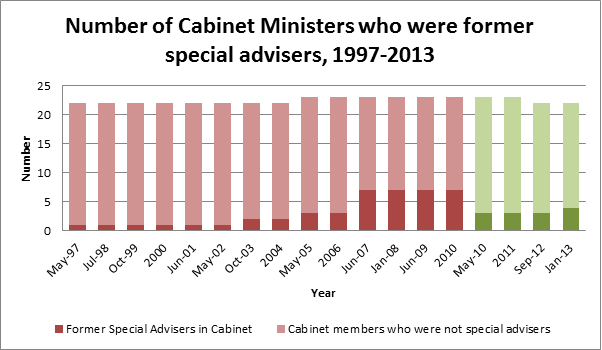
As the Unit’s research makes clear, just 16 Cabinet ministers were previously special advisers. To provide some context: Cabinet usually has 22 full members at any time; and there have been over 500 individuals who were special advisers before May 2010. Less than 5% of special advisers go on to become Cabinet ministers. This suggests that the widespread perception of special advisers as simply politicians in training is mistaken.

Image

British Cabinets are still largely made up of people who have not served as special advisers to Ministers. The Labour government more than doubled the number of special advisers in post at any time, and it is associated with a handful of high profile special advisers turned Ministers. Under Gordon Brown,four former special advisers were brought into the Cabinet. From 2007-2010, former special advisers made up nearly one third of the Cabinet: the highest ever proportion in British political history, though this seems low for the supposed age of the professional politician Whether such levels will be reached or surpassed again is a matter for speculation.

Lord Adonis is on record as praising the experience of being a special adviser as an excellent apprenticeship for future Ministers. He says he benefitted from it. Nowhere else does one get the opportunity to experience life at the top of government as a political actor, learning how Whitehall responds to your requests. Nowhere else can one see the difficulties, pitfalls and routes to success for a Cabinet Minister so closely. Like all apprenticeships, taking this experience on board and putting it into practice when your turn comes round can surely aid performance.

The fact that only a minority of Cabinet ministers were previously special advisers serves to remind us that there is no one route to the highest offices in government. That will come as a relief to critics concerned about the professionalisation of politics and as a disappointment to Adonis and his ilk. In relation to the special advisers project, this information helps us to think clearly about the sort of skills, experience and other benefits that special advisers receive from their job. How much of the success of Cameron, Miliband et al., is due to the skills and political networks they developed during their time as a special adviser?

———————–

The research note contains more detailed information than this blog post and we encourage you to download it here.

MH

Video: In the thick of It: What do special advisers do – and does it make government better or worse?

Duncan Brack and Michael Jacobs

Venue: Archaeology Lecture Theatre G6, Gordon House

Special Advisers are now an established feature of British government: there are currently over 80 of them in Whitehall. But what do they actually do? What relations do they have with ministers and civil servants? Are they – as some have claimed – a threat to the impartiality of the civil service? Or are they essential to make democratic government work well?

Michael Jacobs is Visiting Professor in the School of Public Policy at University College London and in the Grantham Research Institute on Climate Change and the Environment at the LSE.  He was a Special Adviser to Gordon Brown at the Treasury (2004-07) and at 10 Downing St (2007-10).  His major field of responsibility was energy, climate change and environment policy, but he also worked at the Treasury on health, public service reform and the third sector.  Beginning his career as a community worker and adult educator Michael has variously been an economic and environment consultant, an academic environmental economist at Lancaster University and the LSE and (from 1997-2003) General Secretary of the Fabian Society.  His books include The Green Economy: Environment, Sustainable Development and the Politics of the Future (Pluto Press, 1991), Greening the Millennium? The New Politics of the Environment (ed, Blackwell, 1997), The Politics of the Real World (Earthscan 1996) and Paying for Progress: A New Politics of Tax for Public Spending (Fabian Society 2000).

Duncan Brack is a freelance environmental policy researcher. He is an Associate Fellow of Chatham House (Royal Institute of International Affairs) and an Associate of Green Alliance. From 2010 to 2012 he was special adviser to Chris Huhne at the Department of Energy and Climate Change, focusing mainly on UK, European and global climate policy and low-carbon investment. Before that he worked for Chatham House, and from 1998 to 2003 was head of its Sustainable Development Programme; his work included international environmental regimes and institutions, the interaction between environmental regulation and international trade rules, and international environmental crime, particularly illegal logging and the trade in illegal timber. He was also a specialist adviser to the House of Commons Environment Select Committee and Environmental Audit Committee. From 1988 to 1994 he was Director of Policy for the Liberal Democrats.

Find out more about the Constitution Unit’s special advisers project or the SPP seminars