

Chairs and members of House of Commons select committees are allocated between political parties in proportion to their strength in the House. But in practice, a proportional allocation can be calculated in a number of different ways, which produce different outcomes. As the House starts electing its committees, Alan Renwick and Tom Fleming discuss the options and their consequences.
House of Commons select committees are a key vehicle for parliamentary scrutiny. It thus matters how their chairs and members are shared out between the political parties. In theory, these posts are allocated in proportion to parties’ strength in the House: for example, a party with 20% of MPs can broadly expect to chair 20% of select committees and contribute 20% of their members.
However, this principle may be deceptively simple. There are multiple potential ways of calculating a proportional share of committee chairs and members, and different methods can produce different results. Yet the House does not publicly acknowledge or explain its chosen approach.
This blogpost therefore outlines different possible methods and explores their implications. We argue that the House’s approach to this important question should be made public, in the interests of fairness and transparency. Doing so would provide an opportunity for MPs to evaluate the current approach, and to consider the possible alternatives.
What are the rules?
The chairs of the House of Commons’ key select committees are elected by the whole House in a secret ballot. There are currently 26 such committees: 20 departmental select committees plus six others (Procedure, Public Administration and Constitutional Affairs (PACAC), Standards, Petitions, Environmental Audit, and Public Accounts). A number of further chairs are allocated separately and chosen by other means, so we do not discuss them here.
The rules governing the allocation and election of select committee chairs are set out in Standing Order No. 122B (and summarised in recent briefings from the Hansard Society and the House of Commons Library). The process begins with the Speaker proposing a distribution of committee chairs between parties that would, in the words of Standing Order No. 122B, ‘reflect the composition of the House’. The parties entitled to a chair under that proposal then negotiate over which committees they wish to chair, and can also agree to deviate from the Speaker’s proposed numbers. They must then put their agreed allocation to the House for MPs’ approval within two weeks of the King’s Speech. That happened on 30 July, paving the way for the elections themselves, which took place yesterday’.
Once the committees’ chairs have been elected, the parties move to choosing select committee members. As with chairs – although this is not explicitly required in the House’s formal rules – these places are allocated to reflect the composition of the House. The precise balance of parties tends to vary somewhat from committee to committee, with some including members of the smaller parties. The parties each nominate members to fill their allocated spaces, and since 2010 those nominees have been chosen by MPs in within-party elections.
Despite the emphasis on allocating committee roles to reflect the composition of the House, Standing Orders contain no formal provision for how the numbers should be calculated. Nor has there been any official public explanation of the House’s chosen method(s). Yet, as we explain below, a number of potential approaches are compatible with this general principle, with different implications.
What has happened in this parliament?
As noted, the House agreed to an allocation of select committee chairs on 30 July, the last sitting day before summer recess. The agreed allocation gives 18 of the 26 chairs to Labour, five to the Conservatives, and three to the Liberal Democrats. The Conservatives get the two committees which have to be chaired by the official opposition (Standards and Public Accounts), as well as PACAC and two departmental committees (Home Affairs, and Culture, Media and Sport). The Liberal Democrats have two other departmental select committees – Health and Social Care, and Environment, Food and Rural Affairs – and the Petitions Committee.
These chairs were elected yesterday. Parties will now proceed to choose their committee members. There are up to 300 places to be filled across the 26 committees (274 excluding the chairs). As yet, there is no public information on how those spaces will be allocated.
We now turn to exploring whether alternative methods would have produced a different allocation of select committee chairs, and what this might mean for the allocation of select committee members.
Methods of allocating select committee chairs
To produce an allocation of committee chairs, three points need to be decided. The first concerns which MPs are included in the calculations. The Speaker and Deputy Speakers cannot serve on select committees; nor can Sinn Féin MPs, who choose not to take their seats at Westminster. So the calculations below exclude these categories. In addition, Standing Order 122B refers to allocation of committee chairs only among parties, whereas some MPs are independents. While independents have served as committee members in recent years, they might therefore be excluded from the calculations in relation to chairs. Still, only six independents were elected in July (even in a year of exceptional success for such candidates), so including or excluding them will not change the numbers much.
The second point concerns what mathematical formula is used for the allocation. Perfectly proportional allocation is impossible. Labour would, under this condition, receive 16.68 chairs, the Conservatives 4.84, and so on; but clearly each party can hold only a whole number of chairs. A different formula is therefore required to determine the allocation. As is familiar from proportional representation (PR) electoral systems, multiple such formulas are available, of which the most familiar are the largest remainders method with the Hare quota (LR-Hare), the d’Hondt method, and the Sainte-Laguë method. Table 1 shows chair allocations in the current parliament under these formulas. Either d’Hondt or Sainte-Laguë would deliver the allocation that was actually chosen, with 18 chairs going to Labour, five to the Conservatives, and three to the Liberal Democrats. The largest remainders method would have given Labour only 17 chairs, with one being allocated to the SNP.
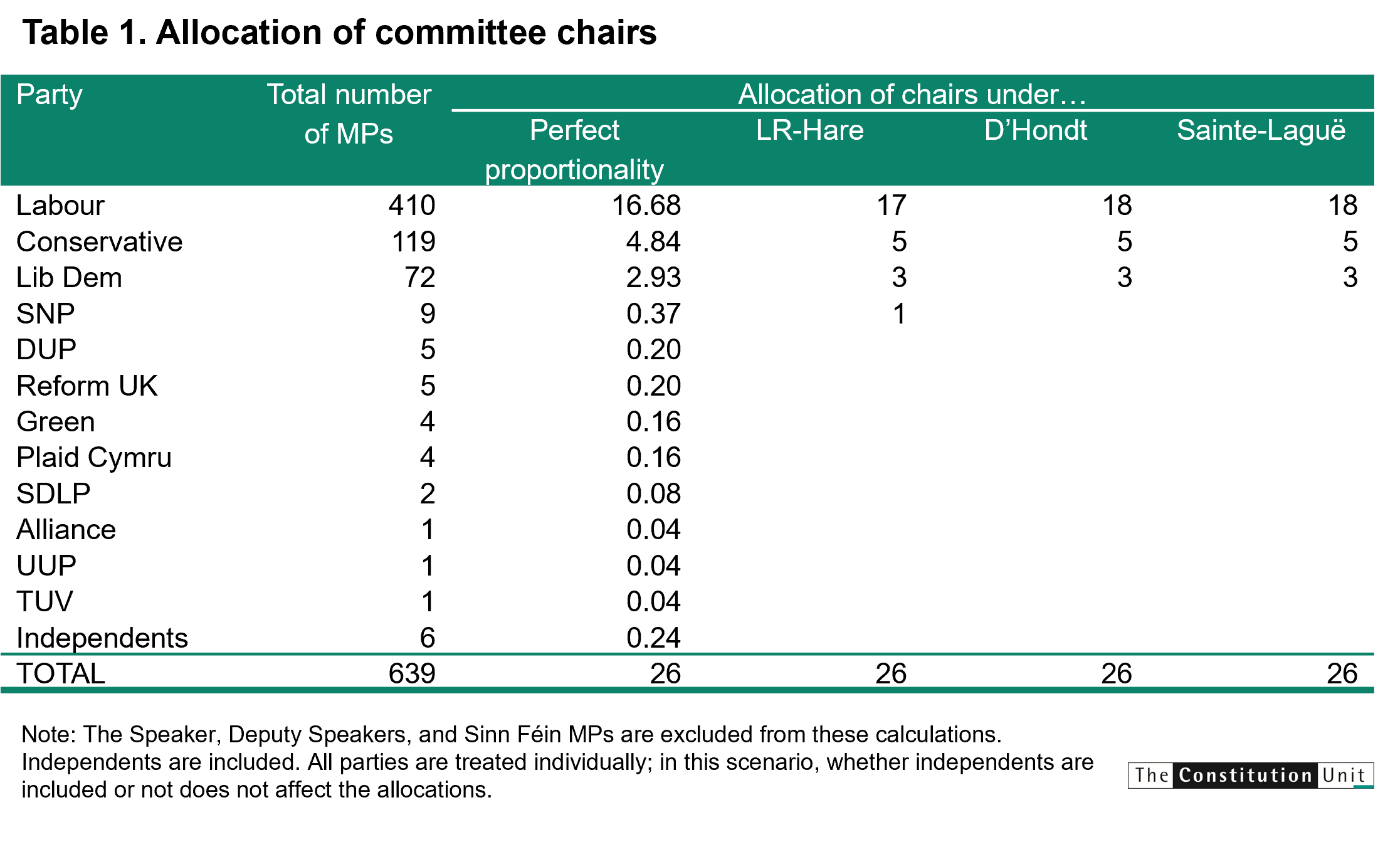
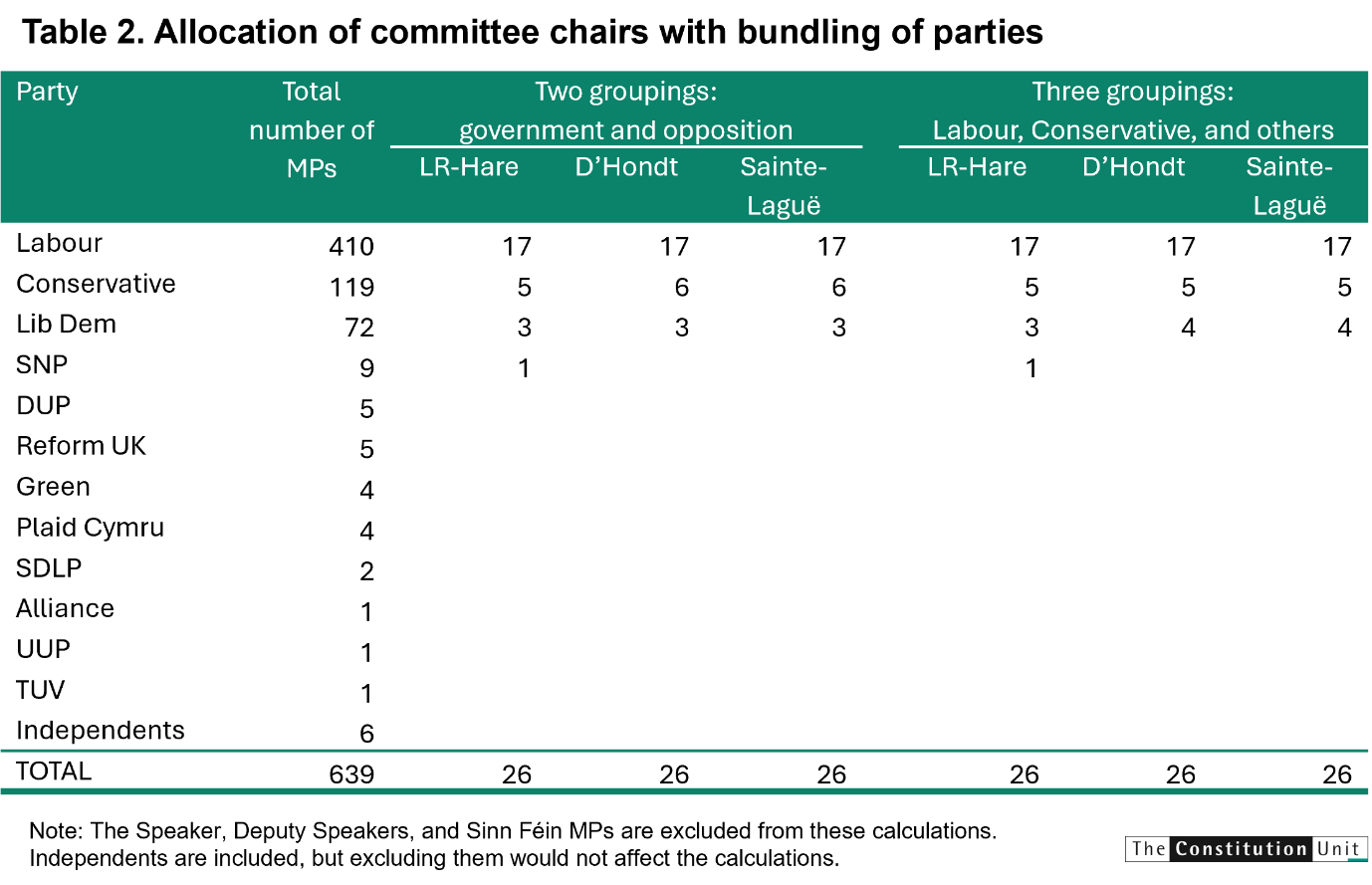
The third point concerns how these formulas are applied. Table 1 applies them to each party separately. But that leads to under-representation of the opposition: because the smallest parties cannot earn a chair’s seat on their own, the fractions of a chair’s position they have earned are effectively ignored. An alternative is to bundle up those fractions so that they do count. This might be done either by combining the shares of all the opposition parties (so that the initial distribution is between government and opposition) or by having three bundles: the governing party; the official opposition; and the other opposition parties. In either case, a second stage would then be needed to allocate seats among the bundled parties.
Table 2 shows the final outcome if such groupings are used. Labour is now restricted to only 17 chairs whatever the formula – much closer to its share under perfect proportionality. The smaller parties now affect the calculations, but this does not actually benefit them: they remain too small to receive any chair positions. Rather, when the extra opposition chairs are allocated, they go to the larger opposition parties. With all opposition parties in one bundle, the Conservatives are the beneficiaries. If the Conservatives are treated separately, they can no longer gain in this way, and the Liberal Democrats become the beneficiaries.
Methods of allocating select committee memberships
Turning to the allocation of the remaining select committee places, the three questions above all matter again. Much more important, however, is a fourth question: is the allocation done committee by committee, or across all the committees together? The first option would, in fact, be intolerably restrictive, and would fail to reflect recent practice. Small parties – even those with just one MP – do receive committee placements: in the last parliament, for example, Caroline Lucas (then the only Green MP) and Stephen Farry (then the only Alliance MP) both had such positions. By contrast, even the most generous of the methods set out so far would restrict the membership of an 11-member committee to just the three largest parties if committee-by-committee allocation were used. An initial allocation across all the committees is therefore required.
This could be done as an allocation of the 274 non-chair positions, to which the 26 chairs are then added. Or it could be done as an allocation of 300 positions, from which the 26 pre-allocated chairs are then deducted. The second approach will sometimes be slightly more favourable to the smaller parties, but the differences are small. The following analysis looks at ways of allocating 274 positions. It assumes that Sinn Féin, the Speaker, and the Deputy Speakers are excluded. Independents are included, reflecting recent practice: the only MP to have been elected as an independent in the four parliaments preceding the current one (the independent Ulster unionist Sylvia Hermon) had a committee position.
Table 3 shows allocations under these assumptions, and without bundling of opposition parties. The pattern here is familiar from studies of PR electoral systems: d’Hondt produces an outcome that is more favourable to larger parties, while LR-Hare and Sainte-Laguë come closer to perfect proportionality.
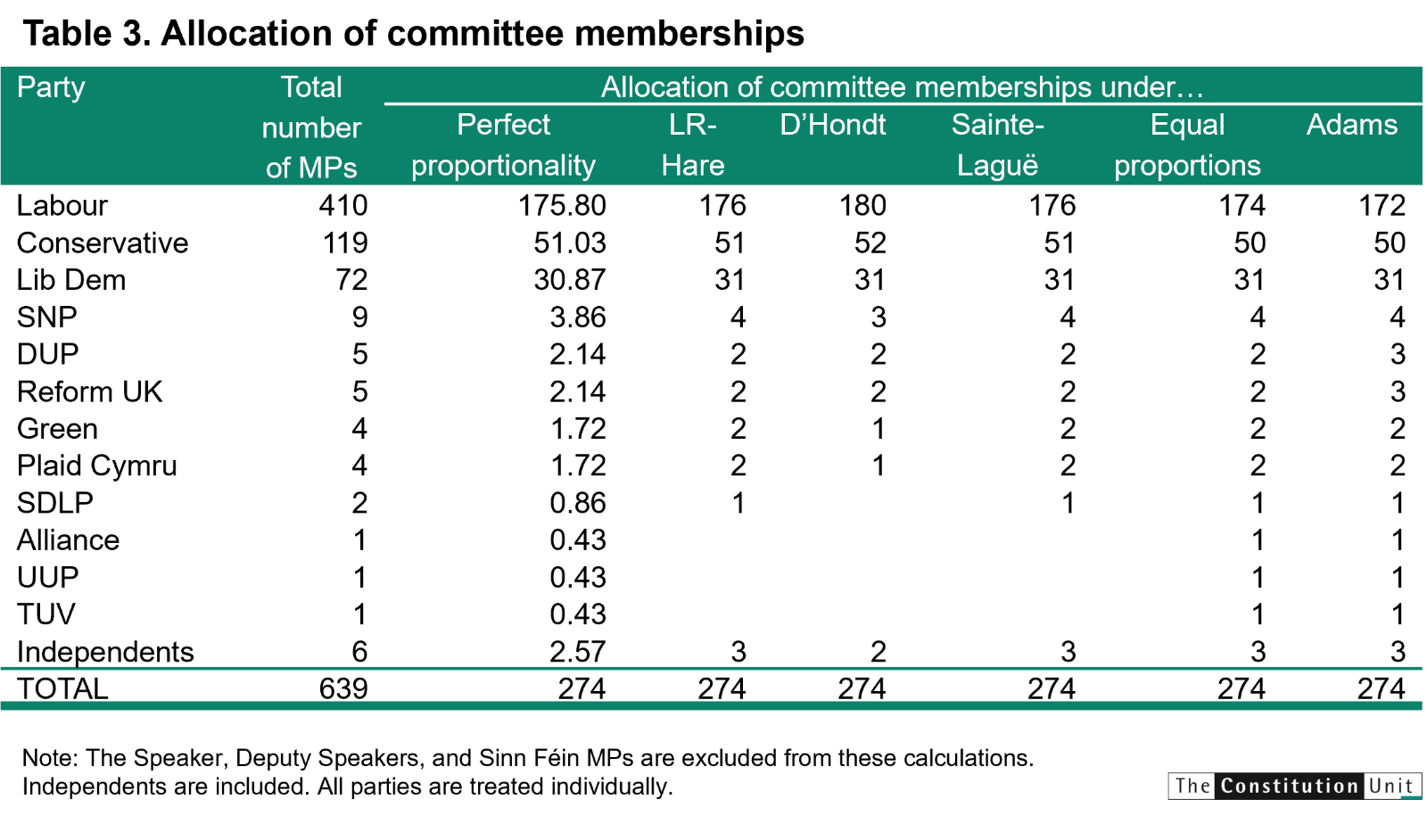
Yet none of the three formulas discussed so far allocates any committee places to the very smallest parties. If the desired result is that all parties should get at least one position – and, as noted, that has been the reality in recent parliaments – a different approach is needed. Simply bundling the opposition parties, as for chairs above, would not solve the problem. One approach would be to allocate each party a seat and then allocate all remaining seats using one of the existing formulas, ignoring that first allocation. This is actually what the rarely used Adams method, also shown in Table 3, does: it gives each party one seat, then uses d’Hondt for all remaining seats. But that ends up being unduly favourable to smaller parties. An alternative is the equal proportions method, which is the system used for apportioning seats in the US House of Representatives across the states. Every state must receive at least one representative, so the task there is analogous to the one examined here.
What approach should be taken?
As the analysis above shows, different methods for allocating committee chairs and memberships lead to different outcomes. In the interests of fairness and transparency, it would be desirable for a specific approach to be agreed and made public. The parties could still deviate from the rule-based allocation if they wished; but the starting point for inter-party negotiations would be unambiguous.
If a specific approach is to be adopted, what should it be?
As has been seen, some methods favour larger parties, some smaller parties; others are neutral. In relation to PR voting systems, bias towards larger parties (as under d’Hondt) is sometimes seen as an advantage, as it disincentivises party splits. But that is not relevant here. D’Hondt should therefore be avoided.
For committee chairs, the goal appears to be to avoid such biases and treat all parties equitably, in which case Sainte-Laguë is the best option (LR-Hare is best avoided, as it can generate anomalies). Given that committees’ primary function is scrutiny of the government, there is a good case for initially bundling opposition parties together in the choice of chairs, so as to avoid over-representation of the government benches.
For committee members, if an additional goal is that all parties, however, small, should receive a committee place, the equal proportions method is optimal. Given that this system guarantees a seat to each party, it makes bundling of parties unnecessary.
The matters we have discussed are technical, but still important. There is no reason to suspect any improper behaviour in committee allocations to date. But greater clarity as to the principles being applied would help prevent any disputes in the future.
About the authors
Alan Renwick is Professor of Democratic Politics at UCL and Deputy Director of the Constitution Unit.
Tom Fleming is a Lecturer in British and Comparative Politics at UCL. He is currently leading the Constitution Unit’s ESRC-funded project ‘The Politics of Parliamentary Procedure’.
Featured image: “Protocol on Ireland/Northern Ireland Sub-Committee” (CC BY-NC-ND 2.0) by ukhouseoflords.