FOI and universities: A report on the experiences of FOI officers in HE institutions

The Constitution Unit’s research project on the impact of FOI on universities is nearing completion. To gain an insight into the experience of universities in dealing with their FOI responsibilities, we conducted a survey of FOI officers working the HE sector and examined FOI requests made to universities contained within a sample of disclosure logs.  The two-part report detailing the results of our analysis of can be found here.

We found the most common problem that FOI officers encountered were related to their colleagues,  with 92% of respondents citing resistance and a lack of awareness of the legislation amongst other staff as having a negative impact on their ability to carry out their responsibilities and respond to requests.  In addition, similar to the findings in our previous study on local government, we found that colleague orientated difficulties appear to be mitigated by a supportive senior management team.

The most frequently reported positive aspect cited by the officers was the increase in transparency and openness that the FOI/EIR legislation encouraged within their institution as confirmed by 73% of respondents. This included improvements in staff attitudes towards disclosure and the amount of information proactive published by the university. However, throughout the survey it was evident, and was also acknowledged by participants, that it was much easier for them to identify negative aspects rather than positives.

The disclosure logs showed journalists and the public to be the most common requesters, accounting for 59% of the 780 requests we analysed between them. The most commonly requested information was related to ‘student issues’, followed by ‘HR and staff issues’ and then ‘teaching and assessment’.

Journalists appear to be much more interested in interrogating student life than students are, accounting for 35% of the requests for information on ‘student issues’ compared to the 7% originating from current students, though several officers commented in the survey that they anticipate that this will increase following the introduction of the £9k tuition fees in the forthcoming academic year.

The disclosure log analysis also provided a useful indicator of the level of impact that controversial research can have on an institution. 13% of the requests we coded were about research, 84% of which were contained within the East Anglia disclosure log. This is demonstrative of the effect that the climate-based research and subsequent ‘climategate’ event had on the type and volume of requests received by East Anglia. Generally research focused requests were for research data itself or the research ‘policies’ of the institution.

Please see our report for the full details of our findings.

The project is funded by the Leverhulme Trust, and is due to be completed later this summer. Please see our project page for further outputs.
FOI and Extraordinary Rendition

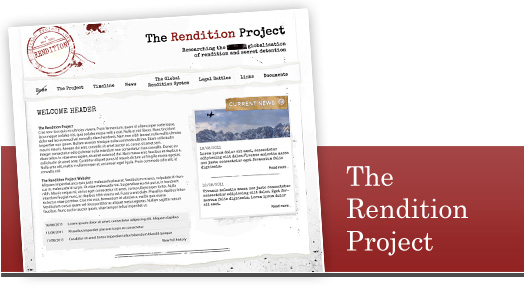
A new website has been launched that aims to piece together data relating to rendition. As well as mapping the system of movement it also gives access to a wealth of documents.

FOI has played an important role in documenting the often complicated movement of flights of terrorists suspects (the movement of which has been linked to torture). The UK All Party Group on Extraordinary Rendition has used FOI to both the UK and US governments to find out about the dubious practice of moving people around the world to be interrogated.  It fought a long campaign to investigate the practice following up Parliamentary Questions with FOIs. There are some examples here.

Controversy over rendition has reignited following allegations that two Libyan dissidents, Fatima Bouchar and Abdelhakim Belhaj, were ‘rendered’ to Libya following Tony Blair’s 2006 visit. Belhaj claims he was tortured and a letter appears to link MI6 to his being moved, though Blair does not recall it.

In a new twist, recently a US judge has refused to release information to the All Party Group on the grounds it was a foreign government entity. He used a very interesting example:

The judge rejected the group’s argument that its members acted as individuals and not public officials. By that logic any foreign leader, including the late Kim Jong-il, could submit Freedom of Information Act requests under their individual capacity, the judge said.

See more background here and here.

UCL Insights

UCL’s research newsletter: read the full text

Just Say No: The Impact of the FOI Veto

The Coalition government used its powers under FOI to veto the release of NHS Risk Registers yesterday, an issue which has been rumbling on since an FOI request by a Labour MP. Andrew Lansley’s full statement is here. He justified his actions as being due to a fear that, if released, future records will be altered and policy made differently (the so-called chilling effect):

This is not a step I have taken lightly. I am a firm believer in greater transparency and this government and this department have done far more than our predecessors in publishing information about the performance and results of our policies. But there also needs to be safe space where officials are able to give ministers full and frank advice in developing policies and programmes.

The Freedom of Information Act always contemplated such a ‘safe space’ and I believe effective government requires it. That is why cabinet has today decided to veto the release of the department’s transition risk register. Had we not taken this decision, it is highly likely that future sensitive risk registers would turn into anodyne documents, and be worded quite differently with civil servants worrying about how they sound to the public rather than giving ministers frank policy advice.

As with the decision over Iraq, it appeared to come down to a different view of what is in the ‘public interest’

The choice to use the veto rather than appeal the decision to publish the risk register was made because the secretary of state and the cabinet views this as an exceptional case where there is a fundamental disagreement on where the public interest lies in relation to the disclosure of the risk register…The upper tier tribunal would focus on points of law arising out of the first tier tribunal decision rather than the balance of the public interest on the evidence.

The Tribunal itself had referred to the Unit’s work in refuting fears of a ‘chilling effect’:

Lord O’Donnell brought to our attention his own view of the likely chilling effect and the opinions of others. There was no actual evidence of such an effect. We note that independent research carried out by the Constitution Unit at University College London has concluded that there is little evidence of FOIA leading to a chilling effect.

What will the consequences be? In the short term the Risk Registers will remain unreleased (though some are arguing for partial release such as Lib Dem David Heath).  To the government, it will probably be better to be criticised for non-release than add fuel to the debate. This will not, of course, stop the controversy.

For FOI, the use of the veto gets easier politically the more it used. As ever this case is the ‘exception’.  However, some feel it sends out the wrong signal and each veto use erodes confidence in the system.

It also adds to growing criticism of the Act from Gus O’ Donnell, Tony Blair and Jack Straw, who called for additional protections for policy makers. This growing concern about FOI reflects the fact that politicians don’t like surprises. It may also be because those high up in an organisation only see the 1 or 2 per cent of particularly troublesome requests, sensitive cases or, worst of all, the ones involving them. So they get a very selective, and very negative, view of what is being asked.

Has David Cameron joined the concerned? He remains very pro-Open Data, even offering us his tax returns, but his recent (albeit brief) comments to the Select Committee indicated some worries about FOI being used for process rather than spending. He also appears to have voiced concern about a ‘chilling’:

Because of Freedom of Information (FoI), he explained, officials and ministers are increasingly reluctant to put on paper what they actually think…Mr Cameron says he is trying to set an example by writing what he thinks on the memos he receives.

It will be interesting to see how he feels about openness if Leveson releases his texts and emails to Rebekah Brooks.

Being Open About Data

The Finnish Institute in London has recently completed a five-month research project on the British open data policies. The report looks at how the open data ecosystem has emerged in the UK and what lessons can be drawn from the British experiences. The year 2012 will be a big year for open data in Finland, and this report also partly aims at further facilitating the development of open knowledge in Finland.
In short, the key arguments that the research makes can be listed as follows:

  • The key to securing the benefits of open data is the quality of user engagement
  • Open data and its objectives should be addressed as a part of the freedom-of-information continuum
  • The decision to emphasise the release of expenditure data was not ideal: governments do not know best what kind of data people want to have and should aim at releasing it all
  • Leadership, trust and IT knowledge are crucial, not only for political leadership but within organisations too
  • The social and democratic impacts of open data are still unclear and in future there is a need for sector-specific research

After a series of interviews and analysis of government documents it became evident that open data is not as apolitical an initiative as many may assume it to be. There is a long history of politicised debate on transparency and public spending behind the initiative. Open data is argued to be a good example of a targeted transparency policy, where proactive release of information is hoped to help in achieving certain political goals. The decision about which information should be released first is after all a political process.

In addition, we must realise the difference between transparency and democracy-oriented goals that are usually associated with the freedom-of-information movement and the technology and innovation-oriented goals of the open-data movement. In the end of the day, the overall value of transparency is not something that should be measured primarily in financial profits.

After a survey of all English local councils and a series of interviews, it seems that public sector data providers are supportive towards the idea of data transparency itself, but very cautious towards the means of achieving it, especially the initiative of releasing the data of expenditure over £500 in local government. Many of the respondents feel that the data released lack information value and due to that the general interest towards data has been minimal.

Open data is applied in various ways with lots of small-scale success stories available, mostly in the form of mobile-phone or web applications. These services make everyday life of citizens a tiny bit easier, and when accumulated they may result in significant economic benefits. However, the open-data community has also been vocal about the potential positive impacts on democracy. These impacts are significantly harder to identify and need much more research in order to produce comprehensive and reliable results.

The report argues that the applicability of data is effectively linked to the initial objectives of open data. The value of open data is built on an uncertain variable and on how people use it – it is difficult to form a single “one size fits all” model, to measure the value of applicability. Data has value only in its use, and at this time it seems that the best way to facilitate its use is to further engage those organised civil society groups who have resources and will to use data with real public-service interests in mind.

Economic impacts can be measured relatively easily with the current methods, but the possible changes in our society due to digitisation of the core infrastructures and the abilities of citizens to manage their lives within it pose challenges for the legitimate and democratic transparency regime. In the future, it is more important to focus on the normative side of open data and on its potential impacts on democracy. There is a risk of creating a hollow mantra of open data improving the level of democracy without any evidence provided. However, the potential for great improvement in democratic accountability is there.

Truly democratic transparency requires more than just the release of open data. It needs citizens who can see that their interests are treated equally in society. If it is hoped that open data will provide the catalyst for this, then the thresholds for access, use and interpretation of data need to be as low as possible. In order to achieve this, the data producers must possess a certain level of ICT knowledge to implement the system so that it is both simple enough to use and sophisticated enough to be able to manage information flow comprehensively – knowledge which is often lacking. This should not be an excuse not to release data, however, but a wake-up call for both data providers and the open-data community alike.

The final report “Being Open About Data – analysis of the UK open data policies and applicability of data” can be read and downloaded here.

Antti Halonen is a PhD candidate at University of Helsinki and a Fellow at the Finnish Institute in London. He is the author of “Being Open About Data – Analysis of the UK open data policies and applicability of open data”.