The finer points of MMP exposed in Scotland

Image

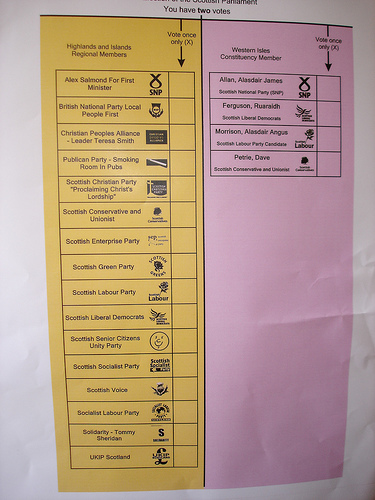
The resignation of two MSPs from the governing SNP in the Scottish Parliament earlier this week over NATO membership is causing more than just a headache for party leader Alex Salmond. It is also exposing a troublesome facet of the mixed member proportional system (MMP)[1] that is used to elect Members of the Scottish Parliament.

A quick briefing on just what MMP is. MMP systems elect two types of member: constituency members, who receive a direct mandate by gaining sufficient votes from within a constituency, and list members, who come into parliament via their position on a regional party list. This list exists to compensate for those votes that were cast for a party where they didn’t win constituency seats. The two MSPs in question, John Finnie and Jean Urquhart, were regional list MSPs (see the ACE Electoral Knowledge Network page on MMP for more).

The existence of list members serves to achieve greater proportionality between votes cast and party representation in parliament. But the implication here is that without allegiance to their party, these members have no mandate to continue to sit in Parliament at all. Senior SNP member Christine Grahame yesterday said the very same, and called on Finnie and Urquhart to resign from Parliament: “the principle here”, she stated, “is you’re here simply to represent a number of SNP votes. You’re no longer in the SNP, you should resign”.

The counter-case looks weak. The SNP code of conduct, for one, is clear on the matter. It states that “any member resigning from a party group at any level of government owes a duty to the party also to resign as a member of the local authority or parliament to which he/she was elected as a party candidate”.

How has this quandary been dealt with in other countries which use MMP?

While floor crossing (the practice of members switching party mid-Parliament) is generally not permitted in purely proportional systems (list PR), it tends to be permitted in MMP systems for the constituency MPs but not the list MPs.

In Germany, while the practice is permitted in law, it has only happened on two occasions in the last fifty years, largely because of the significant negative public perception of party change as an affront to the voter’s preference.[2]

The floor crossing phenomenon became rife in New Zealand following the switch from first-past-the-post to MMP in 1993. It prompted adoption of legislation in 2001 requiring party lists MPs to resign from parliament if they had resigned from the party under which they were elected.

But the problem has been raised even in the UK’s first past the post system. Last November Conservative Westminster MP Chris Skidmore presented a 10-minute order in the Commons which sought to oblige any member who voluntarily decides to change party to resign and fight a by-election. It raised the age-old Burkean questions about what exactly it is that MPs represent: are they delegates acting on behalf of the electorate or rather trustees of the electorate acting according to their best judgment? Party loyalty and discipline only further muddy the waters. However, that debate is less pertinent in the case of the list MP. With no constituency, their legitimacy clearly derives from their party and they cannot lay claim to an individual mandate.

As the Scottish Parliament stands out as a beacon for alternatives to first past the post in the UK, it is worth taking seriously the need to resolve its finer intricacies lest the floor-crossers become an endemic problem.


[1] Also referred to as the Additional Member System in the UK

[2] Electoral Institute for Sustainable Democracy in Africa, ‘Electoral System and Accountability: Options for Electoral Reform in South Africa’ , p.15

Against the Spirit? Use of FOI by Business

A recent study by a district council has found that business users make up more than 50% of requesters.  This local paper explained :

A study of a three-month period between March and May revealed Broadland received 191 requests, with each one taking an average of 56 minutes to complete – the maximum amount of time allowed without a charge is 18 hours. Broadland believes commercial sources submitted 63pc of the FOIs.

And Kim Davis-Claydon, cabinet member for operations and resources, told today’s cabinet meeting: “Nearly £15,000 is an awful lot of money in the current economic climate and there’s lots of better ways to spend it.

“The principle of the Freedom of Information Act is great, when used properly, but I really feel the commercial world is abusing the system.”

The study also found that private individuals and campaign groups both made up 8 % of all requesters and academics 2%. (see the full report here ). The use of FOI by businesses seems to be much heavier at local level than at central government level, as our report showed. Officials felt that businesses using FOI, particularly for commercial again, was against the ‘spirit’ of the Act.

SCOTS DEGREES OF SEPARATION

Earlier this year I wrote on this Blog about various aspects of ‘Scotland and the UK’ here, here and here.  Now, the crucial question over the next two years is a superficially simple one: “What does ‘Scotland as an independent country’ mean”?

It should be a truism that voters at an election or referendum should know as much as possible what/who they are being asked to vote for.  This is essential for democratic and legitimacy reasons. Yet, so far, this doesn’t seem to be the case in the 2014 Scottish independence referendum.  It seems that qualifying Scottish voters will be asked simply to agree or disagree with a general, almost abstract, ‘in principle’ proposition, rather than to support or not support a particular constitutional ‘settlement’, as in earlier such referendums in 1975 and 1997.

What would independence mean?

The main – for most potential referendum voters, the only – ‘independence’ on offer is that of the SNP.  Some argue that this form of independence is in reality a strong variant of ‘devo-max’ (‘devo-extramax’? ‘independence-lite’?), because of all the proposed continuing links to UK institutions and policies etc..  Does this matter?

In some sense, all independence in the modern world is relative, especially in practical political, economic and military terms.  The present UK’s sovereignty, practical as well as legal, is less than pure and total, because of membership of bodies such as the EU, NATO and UN, for example.

Again, it can be argued that the SNP’s evolving version of Scottish independence is driven by the realpolitik of winning over voters to the YES camp in 2014, rather than by some theoretical or romantic ideal of independence.  It fits in with the SNP policy of gradualism, presenting post-2014 independence as simply the final, painless step in the devolution journey, completing the process begun in the late 1990s of the creation and development of a Scottish Parliament (and accompanying Government).  In this scenario, many voters may not even realise the political and constitutional significance of the referendum.

Yet, notwithstanding any camouflaging words and policies, at some point there must be a Rubicon to be crossed when Scotland becomes, and is recognised as such, an independent state.  I’m not an international lawyer, but there are at least two relevant aspects of independence here, where Scotland’s status becomes definitively more than devolution, federalism or the like, still ultimately part of a wider independent state, ie the UK:

  • International recognition of independent statehood: it is not just a question of whether Scotland should itself belong to bodies such as the EU, UN or NATO, but whether it can be, is qualified to be, a member of such bodies;
  • Legislative supremacy: the post-independence Scottish Parliament, not the Westminster Parliament, would be the repository of ultimate legislative power, whether or not limited by any ‘higher’ written constitution or by external supranational bodies like the EU.

Pathways to independence

In theory there are various ways in which Scots can have the opportunity of giving ‘informed consent’ to independence.  Whether or not some of these are politically practical or realistic is a different question.

While SNP gradualism implies a degree of ‘independence-by-stealth’ in winning a referendum, there would presumably also need to be some parallel narrative or ‘creation myth’ which is more heroic, resonant and visible, recognising and glorifying that crossing of the independence Rubicon.  This may require, however symbolically if not (in terms of the various relevant jurisdictions) legally, some form of ‘Treaty of Disunion’ as the constitutional bookend to the 1707 Treaty/Acts of Union.

From the UK point of view, Scottish independence would presumably be achieved legally by an Act of the UK Parliament, whether or not accompanied by, or incorporating, any separate ‘treaties’ or other written agreements.  In Scottish domestic symbolic, as well as international law, terms, such a Treaty of Disunion would be made between ‘independent’ states, rather than between a sovereign state and one of its component parts, and it would be this, and any accompanying ‘declaration of independence’ and Constitution, which would be regarded within Scotland as the crossing of the independence Rubicon.

What role, if any, would or should the Scottish people have in any such process?  If there is no pre-referendum detailed elaboration of what ‘independence’ actually means, other than what is said by the various parties and any official umbrella YES/NO groupings, there is a democratic case for a further recourse to the people, by way of a second referendum or otherwise, once a detailed independence deal is finally negotiated, .

If that is not feasible, then there is an argument for some form of ‘constitutional convention’ where the people’s representatives can discuss and ‘decide’ on the terms of Scottish independence.  This would be in tune both with recent Scottish constitutional practice, and with more general modern trends towards participative democracy.  This could be held after a YES vote, and any such ‘settlement’ can then form the basis of whatever constitutional mechanisms (treaties, legislation etc) are used to achieve independence.  It could even be held before the 2014 referendum, so that voters can then see, in detail, the independence package they are voting about.  Scotland has some, albeit unofficial, experience of constitutional conventions; the Commons Political & Constitutional Reform Committee under Graham Allen is currently holding an inquiry on this very subject, and the McKay Commission on the West Lothian Question can more usefully spend its valuable time and expert resources in examining how inter-parliamentary relations with the UK can positively contribute to any such convention and independence-pathway process.

The role of general elections?

There is also the fact of upcoming elections, not just the Holyrood elections in May 2016, but the Westminster elections in May 2015.  If there is a YES vote in late 2014, what would be the purpose, even the point, of the UK general election in Scotland mere months later?  Never mind the parliamentary and governmental impact of the departure of all Scottish MPs at some future date during that 2015 Parliament, would these MPs be, and be seen to be, mere lame ducks, or will they be regarded (if only by themselves) as the UK-level supervisors of the independence process?

And what of the 2016 Holyrood election?  Is the idea that it will be somehow transformed into the first elections to a sovereign Parliament of an independent Scotland, or will they be the last elections to a devolved Parliament within the UK, a Parliament largely devoted to negotiating and finalising a independence settlement?

Arguably, either or both these elections could be utilised to contribute to some form of constitutional convention, albeit a post-referendum one.  Either formally or otherwise, the Scots MPs elected in 2015 could form part of such a convention, perhaps with the existing MSPs and, if thought desirable or necessary, other representatives of Scottish civil society.

Time is short

The late 2014 referendum may seem a long way in the future, but, in constitutional terms, time is actually very short, especially when considering such novel, complex and highly sensitive, even incendiary issues such as those discussed in this blogpost.  The Scottish referendum electorate – as well as ‘expatriate’ Scots, and everyone else in the rest of the UK – do not just deserve to hear the views of all interested parties, but should also start making known their own views on their constitutional future NOW.

The latest special adviser reshuffle

The full breakdown of special adviser movement.
Note: an asterisk denotes change due to Lena Pietsch’s return from maternity leave; SSoS refers to ‘Senior Secretary of State’.

Last Friday, the Cabinet Office published the first list of special advisers (spads) in post since the September 2012 reshuffle.

It appears they were uploaded at 7.08pm that night. An hour earlier, Andrew Mitchell had resigned his post as Chief Whip. Mitchell had only just appointed a new spad, Meg Powell-Chandler, and he may have been planning to appoint another. Since spads’ appointments are technically terminated when their appointing Minister leaves office, Powell-Chandler’s tenure was abruptly cut short.

Andrew Mitchell’s replacement as Chief Whip is Sir George Young, who left the Cabinet only six weeks earlier. His return brings the possibility that Robert Riddell, his spad as Leader of the House (2010-12), will make a return to government. Young is unlikely to keep on Powell-Chandler or appoint anyone else, because the Chief Whip under Coalition has so far only taken on one on spad, giving the other ‘slot’ to their deputy from the partner party.

Since the reshuffle, a couple of significant appointments have been made at the centre of government, with Oliver Dowden and Ryan Coetzee being brought in to the Prime Minister and Deputy Prime Minister’s offices, Dowden as Deputy Chief of Staff And Coetzee as Clegg’s chief strategy spad.

Some line departments now have more than two spads. Michael Gove and Iain Duncan-Smith now have three spads each. Another impending appointment means that BIS will now have four spads in the department: two for Vince Cable, two for the Conservative ‘junior’ ministers, Michael Fallon and David Willetts.

Jeremy Hunt has kept one of his spads from DCMS, Sue Beeby, and has agreed to appoint a second spad, Sam Talbot-Rice. Talbot-Rice is not included on Friday’s release because he had not started in his post. The Constitution Unit understands that he will take up his post on November 19 and will act as Hunt’s ‘policy special adviser’. Chris Grayling (MOJ) and Maria Miller (DCMS) are two Secretaries of State likely to hire a second spad soon.

Both of Andrew Lansley’s spads at DH have left the government, unique among spads with reshuffled ministers. The only spad to leave their post without their minister being reshuffled was Bridget Harris. She was one of the six Lib Dem ‘departmental’ spads appointed to monitor developments across government, reporting to Nick Clegg.

Three spads have moved to work for different ministers in different departments. Amy Fisher has moved from Defra to MOJ; Victoria Crawford from DFT to DFID; Guy Levin from DCMS to DFID. That is unusual: spads are usually personal appointments, and move with their minister.

Jonathan Caine is unique as spad to the Secretary of State for Northern Ireland. As predicted in a previous blog post, he is the only spad who has remained in a department in spite of a change of Secretary of State. That may be explained by his previous history: he was a spad in NIO under John Major for five years before being brought back in 2010. Arguably, he is an ‘expert’ spad.

But it is worth noting that the pending appointment in DH and BIS means that the Government will soon set a record for the number of spads in government. With fourteen joining and only ten leaving, the number of spads in post increased between July and October 2012 from 81 to 85. But the reported appointments at DBIS and DH as well as potential appointments in the Whips’ office, MoJ and DCMS mean that the number of spads can be expected to reach 87 and perhaps as high as 90, topping the previous record of 85 spads in 2004 under Labour. The rise in numbers may be brought about by the fact of coalition (and the need for greater cross party interaction); and recognition of the need for more politically committed advice and assistance to Ministers. But it is also a product of the rise in the number of ministers in the Coalition Government—especially ministers attending Cabinet.

Last weekend, the Public Administration Select Committee (PASC) published its report ‘Special Advisers in the thick of it’. The Committee came out against a cap on the numbers of spads. That was sensible: the focus should be on the effectiveness of special advisers, not their numbers. Spads are here to stay, and the sooner we have a dispassionate and informed debate about their role, the better. But whether or not the public and Westminster observers will agree is a different matter.

MH

[This post was edited on 23/10/12 to take account of Coalition practice in appointing spads to whips.]

Judicial Independence and the Supreme Court

On 3 October the Judicial Independence Project held the fifth in our series of practitioner seminars on ‘Judicial Independence and the Supreme Court’. The seminar was run under Chatham House Rule but we have prepared a short note available on our project website: read the note.

Amongst the points made by contributors was that statistics do not bear out the popular perception that the Supreme Court is exercising more power over the Scottish legal system than was the case prior to Scottish devolution. Although there has been an increase in the volume of cases going from Scotland to the Supreme Court (and its predecessor the Appellate Committee of the House of Lords) the success rate for Scottish appeals was essentially the same as that for other cases under the Appellate Committee, and since the creation of the Supreme Court in 2009 the success rate for Scottish appeals has been notably less than that of others.

There were differing views on appointments to the Supreme Court. The Crime and Courts Bill proposes to remove the Deputy President from the appointment commission for the Court. Some regarded this as negative: the justices of the Court have the best knowledge about what the court needs in new appointments. Others disagreed, arguing that while this might be true, no part of government in a democracy should be self-replicating.